February 27, 2022

Questions Boards Should Ask to Guide Cybersecurity Preparedness

"Boards are demanding more oversight of cybersecurity," says EY, a consultancy, in a report on how boards can help the companies they govern be better prepared to prevent cyber attacks. After surveying "411 CEOs, chief information officers (CIOs) and other cybersecurity decision-makers about their companies' use of information security solutions," the report reveals "that simple actions taken now can reap substantial rewards later." The report adds that "[t]hese lessons," which are outlined below, "have emerged from those who have experienced major breaches."
  1. Focus on "zero trust." "Zero trust security is not a single technology, but a holistic approach to security, incorporating different cyber principles across people, process and technology. The basis of the concept is the assumption that there are threat actors within and outside of organizations, so no users or machines should be trusted. All users and devices (both inside and outside of the organization) are authenticated, authorized and continuously validated for security configurations and context before accessing applications and data."
  2. Educate and involve your board now. "Not surprisingly, boards of directors are increasingly interested in preventing data breaches and determining how to prioritize cybersecurity needs. Executives that have experienced a data breach say the experience has taught them to involve many more stakeholders in cybersecurity decisions, including boards. Companies should proactively create a board-level executive dashboard, while simultaneously briefing the board about cybersecurity issues at least once per year."
  3. Reinforce the role of the CISO as a strategic partner to the business. "During the pandemic, every organization had to adapt to a new way of working. However, the speed of change came with a price. Seventy-five percent of companies saw increases in the number of disruptive attacks during the pandemic. In this sense, many companies were forced to adapt to a different cyber risk profile just like an organization has to do after experiencing a breach. CISOs had and still have an opportunity to reinforce their value proposition with the business. With the onset of the pandemic, 55% of cybersecurity leaders believed this gave them an opportunity to position themselves as strategic partners to the business. Dave Burg, EY Americas Cybersecurity Leader, noted that 'I know of many security officers who were viewed as superstars, and we want those superstars to be brought to the front of innovation.'"
  4. Assess usage of managed security service providers. Keeping up with the latest security technologies and evaluating threats are the most challenging pain points for today's CISOs. Companies that have recently experienced a breach are more likely to outsource cybersecurity responsibilities after the breach. By starting the time-consuming process of reviewing outsourcing options and vendor capabilities prior to a breach, companies can develop the best security architecture and posture."
  5. Spend now, save later. "According to the survey, companies that have recently experienced a breach expect to spend more across all security domains, with vulnerability assessments and access controls expected to see the largest budget increases. To protect themselves from today's sophisticated attacks, companies must bolster their cybersecurity capabilities or outsource them to external vendors. Many executives make decisions to bolster capabilities to not only prevent attacks, but also to mitigate the damage and shorten the recovery time."

The report importantly notes that "In today's environment, corporate boards are increasingly held accountable for cybersecurity and resiliency. Boards may want to focus on the governance of their enterprise-wide cyber programs, while the highly technical CISO focuses on the risk management aspects." Moreover, "To help facilitate productive discussions, EY US has developed the following key questions about effective cybersecurity oversight that boards can refer to during an intrusion."

1. Was the organization affected by this intrusion?
  • If yes, how is the organization mitigating and responding to the vulnerabilities identified?
  • If not, what proactive measures were deployed to prevent a similar intrusion?
2. What is the potential impact of the intrusion?
  • Which areas of the network, including data assets, were compromised?
  • What is the total risk exposure, including financial, regulatory, reputational and operational impacts?
  • Has an independent third party assessed the network to analyze the extent of the impact?
3. How effective was the response plan?
  • What gaps were identified in the investigation, containment, eradication and recovery processes?
  • Does the company have appropriate insurance coverage? Has the insurance provider been engaged?
  • What lessons were learned?
4. Are third-party and supplier ecosystems secure?
  • Have any of the company’s third parties and fourth parties been compromised?
  • Do any of those parties have access to the network?
5. Is the company focused on preventing and responding to future compromises?
  • What is the efficacy of the company’s current cyber risk management efforts? Should the company’s risk appetite be re-evaluated?
  • How does the company become more resilient to future incidents?
  • Where should the next cybersecurity dollars be invested based on the evolving threat landscape?
  • Has the company built cyber diligence into its acquisition and integration plans?

Based on regular discussions I have with cybersecurity professionals about how their role of keeping their organization's IT systems secure is an arduous battle that goes on each and every day throughout the year, I appreciate the report's conclusion:
Unlike many corporate functions, cybersecurity departments don't have an off season or a period of reduced activity and demand. For cybersecurity professionals, every day is a race against time and resources, and a balance of competing priorities. Corporate cybersecurity executives are faced with a choice — take simple steps now to lessen the impact of future breaches or continue operating in a reactive mode and responding to daily demands and possibly facing the fallout from inevitable breaches.
As an article by The Economist points out that: "Corporate boards need to have a stronger grasp of the threat levels. As one former cyber-spook says, they need not just gender and racial diversity but technological diversity, too, in order to grill the company's techies on cyber-defenses. Furthermore, they need to recognize cyber-war as one of the growing number of geopolitical risks that firms face."

Do you agree with the findings of EY's survey? What questions should boards ask to guide cybersecurity preparedness?

Aaron Rose is a board member, corporate advisor, and co-founder of great companies. He also serves as the editor of GT Perspectives, an online forum focused on turning perspective into opportunity.

February 7, 2022

Report Presents Relevant and Timely Questions Directors Should Ask in This New Era

The coronavirus pandemic has presented a company's board of directors with unforeseen challenges that tests long-held principals in governance and leadership. The balance of mitigating risks while keeping an eye of corporate growth will be a challenge for directors in this new era. Taking a philosophical approach to business strategy throughout my professional career, I support the following notion made by EY, a multinational professional services firm: "We believe that better questions lead to better answers and a better working world. Likewise, we believe that a board's most effective tool is asking compelling questions. These questions can lead to better governance and organizations that drive value for all stakeholders."

Produced annually by the EY Center for Board Matters, the 2022 report presents a list of relevant and timely questions, segmented by four themes, for a company's board of directors to consider:

Theme 1: Strategy and innovation - Strategy that positions companies to innovate and differentiate for a sustainable future
  1. How is the company rethinking its definition of "long term" to maximize value while also focusing on near-term risks and opportunities? Is the strategy appropriately focused not only on where the company is going, but where it can go?
  2. Are material environmental, social and governance (ESG) issues considered in the company's long-term strategic planning? How do the company's business model, practices, products, and services address urgent environmental and social challenges as we move toward a more inclusive and sustainable future?
  3. What data and metrics are being used to assess the health and vibrancy of the organization's culture and its alignment with strategy? Is the culture appropriate to inspire and enable innovation?
  4. Is the company's capital allocation aligned with the necessities of its long-term strategy? How is the company addressing barriers toward optimal allocation?
  5. Does the board have the appropriate governance process to oversee strategic investments that seed innovation to change the game? How is it supporting the acceleration of idea generation, trialing and assessment while also encouraging appropriate risk-taking?
  6. Has management appropriately considered partnerships, joint ventures and alliances, along with M&A, to accelerate the strategy, particularly with longer-term adjacent and transformational opportunities?
  7. Are newer and innovative technologies, including digital platforms and cryptocurrency solutions, appropriately leveraged to accelerate goals and objectives? How can these technologies accelerate the speed to market and enhance virtual collaboration and customer engagement?
  8. What is the company's transition plan for thriving in a net-zero future? Is that plan integrated with the company strategy? Does it include specific short-, medium-and long-term greenhouse gas reduction targets and related decarbonization initiatives? How is the company preparing for additional climate-related disclosure requirements?
  9. How is the company investing in protecting and restoring the natural ecosystems and biodiversity on which its business relies?
  10. Does the board understand the company's supply chain constraints? Is the board confident that the supply network is flexible and agile amid continued global supply chain challenges? How is it addressing increased calls from stakeholders for sustainability and less waste?

Theme 2: Talent oversight - Broader oversight of culture and talent that is prepared for the transforming labor market
  1. Do scenario analyses consider an appropriate range of extreme and even improbable scenarios, including existential threats? Do they incorporate the potential compounding effects of various risks, such as supply chain disruption, talent acquisition and retention, inflation, future interest rates and an evolving tax landscape?
  2. Are contingency and response plans related to material and high-impact risks, such as cybersecurity breaches and natural disasters, periodically simulated and reviewed with the board?
  3. How is the company revisiting and adapting its risk management strategy and management's approach to the three lines model in response to potential changes in the external and internal environment, changes in the strategy and risk landscape, and the company's operating model?
  4. Has the board considered how the organization's risk assessment capabilities are evolving, including how analytics, artificial intelligence and other emerging technologies can be used to review and validate data and information to unearth insights into enterprise risks and opportunities?
  5. How has the company's cybersecurity risk management program evolved to address the current environment in which attackers are targeting a larger surface area and using increasingly unpredictable tactics? How are cybersecurity and data privacy considerations proactively integrated into all major strategy or tactical decisions, such as transactions, alliances, new products or services, and technology upgrades?
  6. What types of data is the organization collecting from its customers and other stakeholders to better assess the trust, risks and opportunities related to changing preferences and needs? How is the collection occurring?
  7. How is the company scanning and assessing geopolitical developments, including a rapidly changing trade and regulatory landscape and governments moving to a more interventionist policy position?
  8. What is the company doing to address material social risks across its value chain, including the treatment of employees and suppliers' human rights practices and impacts on customers and the communities in which it operates?
  9. How is the company assessing the impact of physical and transition climate risks on products and services, supply chains and operations that can materially affect operating costs and revenues across the enterprise?
  10. Has the organization's tax planning strategy been reevaluated to address potential tax policy changes, as well as impacts arising from potential shifts in the supply chain and capitalization? Has the organization considered growing stakeholder interest in tax transparency and potential related reputational impacts?
  11. Does the board understand and approve the company's data privacy and data usage policy? How is customer and employee data use managed? Are social surveillance algorithms reviewed for bias? Is data protection considered beyond cybersecurity protection?

Theme 3: Risk and resiliency - Risk management that enables resiliency amid new and evolving challenges
  1. As the nature of work and employment further transforms, how will the organization adapt its talent functions to realize its strategy? Does the board spend the same amount of time with the chief human resources officer (CHRO) discussing data and metrics to assess the health and welfare of the workforce as it does with the CFO reviewing and assessing the overall financial health and stability?
  2. To attract and retain talent in a hypercompetitive labor market, how is the organization implementing plans to address calls for better pay and benefits, including flexibility, the opportunity to work from anywhere, programs to enhance well-being, and funding for training and educational advancement?
  3. How have the desired skills and behaviors for the organization's leaders evolved in response to the events of the last two years, and how has the board's succession planning and oversight of talent development changed in response?
  4. Given that more than half of employees say they would leave their job if flexibility in their schedule and work location is not extended after the pandemic, has the organization considered how to make flexibility integral to the company's human capital strategy?
  5. How is the company seizing strategic opportunities to tap into larger talent pools, diversify across numerous dimensions and expand working hours across time zones, while being mindful of work location, regulatory and legislative challenges?
  6. Is the board comfortable with how the organization is nurturing its existing and future talent pools (e.g., reskilling and upskilling, educational alliances) to position the company to meet current requirements, address enterprise risks and prepare for continued strategic pivots?
  7. How is company leadership enabling cross-functional collaboration and seeking input from a broader set of internal constituencies to support an inclusive culture, enhance engagement and spur innovation? How are these efforts measured?
  8. Are there any efforts to identify and address disconnects between how management views the employee experience and the employee's actual experience? Are employee engagement scores, periodic pulse checks, summaries of exit and onboarding interviews, and social media data routinely reviewed?
  9. With continued virtual work, how is the company addressing any impacts on employee engagement, inclusion and career development?
  10. How is the company embedding diversity and inclusion into its workplace policies and human capital management programs throughout all steps in the employee life cycle to enable equitable opportunities, advancement and compensation?

Theme 4: Dynamic governance - Dynamic governance that addresses expanded and changing oversight requirements
  1. How is the board adopting a continual learning mindset and strengthening its education program? Is the program sufficiently tailored to the company's and individual board member's needs, seeking diverse views from inside and outside the company that allow for challenges to status quo thinking?
  2. How can the board's structure be refreshed to be more agile, future-focused and aligned to the risks and opportunities on the road ahead? Is the board considering the use of ad hoc committees made up of directors, management and third parties to address specific strategic issues?
  3. How is the compensation committee evolving its charter to address oversight of broader human capital issues? How does the board hold senior management accountable for progress against related goals via incentive plans and other reward mechanisms? How is the company preparing for ongoing human capital disclosure requirements?
  4. How is the company refreshing its investor engagement strategy to be more efficient and productive? Is it considering new engagement approaches (e.g., more collaborative engagement via working groups or investor days)? Is it leveraging the proxy statement and other disclosures as communication tools?
  5. How is the board thinking like an activist in considering and proactively addressing the company's operating vulnerabilities? How is the board obtaining an unfiltered view of shareholder feedback on the company's strategy and pace of performance? Do select individual board members have direct dialogue with shareholders to understand their priorities?
  6. Are information flows to the board being appropriately challenged to include more forward-looking and predictive insights, coverage of emerging risks, external perspectives, and corroborating data from third parties to keep pace with the evolving market, economic and geopolitical developments? Is a consent agenda used to maximize board discussion of strategic initiatives?
  7. How is the board expanding its director search to maximize diversity and broaden board competencies in critical areas such as technology, human capital management, cybersecurity, and sustainability, and how are those individuals onboarded to set them up for success?
  8. With increased board diversity, what changes to its protocols are being made to leverage diversity of thought, improve decision-making and create an inclusive boardroom?
  9. Is the board prepared for increased accountability as ESG matters become a multi-stakeholder priority and investors increasingly embrace proxy votes against directors as their most effective tool to accelerate progress on ESG matters?
  10. With growing scrutiny of sustainability reporting and stakeholder concerns around greenwashing, how is the board — particularly the audit committee — overseeing nonfinancial disclosures made in regulatory filings, sustainability reports, analyst calls and other mediums? Are internal or external assurance procedures applied to material assertions and data?
  11. Is the company progressively reporting on human, customer and societal value to attract capital and meet the increasing demand of stakeholders for consistent and comparable ESG and other nonfinancial‑related data that aligns with evolving external frameworks?
  12. What is the board's policy for timely review of corporate political and lobbying expenditures and any public political positions taken by senior executives? How is the board assessing the alignment of those expenditures and positions with the company's values, commitments and strategy?
  13. Could the board create more effective meeting agendas and protocols (e.g., consent agendas) to increase director engagement on priority matters? Can virtual sessions augment and enhance traditional in-person meetings?

The report insightfully notes that companies will "continue to refresh their strategy to strengthen agility, resiliency and sustainability and leverage innovative opportunities that can accelerate their performance over the long term." Importantly, "Trajectories of companies that are thriving and leaning into this strategic reset are diverging rapidly from those that are merely surviving."

Moreover, "Boards have both the opportunity and the responsibility to help guide companies in this new era. They can support their companies in incorporating human and natural capital as part of business decisions and strategy, and harness risks as opportunities for innovation and a competitive advantage." I concur that this cannot "be achieved through a historical governance model. Boards should continue their own transformation to a new agile and dynamic form of governance and continuously challenge their composition, committee structure, agendas, and ways of working to position their organizations to thrive in the long term."

I appreciate how EY's report provides directors with insights and questions to consider as they engage with management on a variety of complex boardroom issues. What questions do you think directors should be asking to help companies in this new era?

Aaron Rose is a board member, corporate advisor, and co-founder of great companies. He also serves as the editor of GT Perspectives, an online forum focused on turning perspective into opportunity.

February 4, 2022

Report Presents Policy Recommendations to Better Support Women-Owned Businesses in the US

"As of 2017, there are 11,684,549 women-owned businesses in the United States accounting for 37.6% of all businesses," according to a report published by the National Women's Business Council (NWBC). "Revenue for all women-owned businesses in 2017 was $1,776.4 billion. The U.S. Census Bureau (Census Bureau) defines majority women-owned businesses as having more than 50% of the stock or equity in the business."

The NWBC, a non-partisan federal advisory committee created to serve as an independent source of advice and policy recommendations to the President, Congress, and the U.S. Small Business Administration (SBA) on economic issues of importance to women business owners, says approximately 38% of all businesses in the U.S. are women-owned and 80% of women business owners are over the age of 35. While there are over nine million women-owned businesses in urban areas accounting for 77% of all women-owned businesses and 38% of all urban businesses, there are 1.6 million women-owned businesses in rural areas accounting for 13% of all businesses and 35% of all rural businesses.

The report also presents policy recommendations on a different segments starting with improving access to capital and opportunity such as spotlighting successful venture funds investing in diverse women-founded enterprises, building back a better pipeline of women entrepreneurs, reassessing and strengthening SBA’s microloan program to better serve women entrepreneurs in emerging markets, and narrowing the wealth gap for women entrepreneurs by ensuring parity for the SBA’s women-owned small business (WOSB) and economically disadvantaged women-owned small businesses (EDWOSB) federal contracting programs.

With respect to rural women's entrepreneurship, the NWBC provides policy recommendations to improve promoting succession planning among rural women entrepreneurs, providing relief for women inheriting rural family businesses and farms, evaluating gaps in data for rural women business owners and farm operators, addressing family and child care concerns as barriers to women entrepreneurship, and advancing diversity, equity and inclusion to support rural minority women business owners.

On the topic of women in science, technology, engineering, and mathematics (STEM), the report outlines policy recommendations for advancing gender equity in STEM business and innovation and promoting commercialization of new technologies, increasing STEM business mentorship and education opportunities, supporting STEM accelerator programs partnering with minority serving institutions (MSIs) and historically black colleges or universities (HBCUs), and improving demographic data collection on minority women inventor patentees.

Having served as an advisor to women-owned enterprises, I have witnessed the exorbitant long time it takes for the SBA to review applications to receive a WOSB/EDWOSB certification. Therefore, I support the recommendation that the "SBA should improve the turnaround time for obtaining a WOSB/EDWOSB certification, and both Congress and SBA should work to ensure parity of the program by leveraging the same or greater contracting expectations, authority and penalties as other certification and contracting programs."

Moreover, the NWBC recommends that SBA's Ascent platform highlight and include relevant, existing federal resources uniquely tailored for women STEM entrepreneurs including links to existing Small Business Innovation Research (SBIR) and Small Business Technology Transfer (STTR) program online tutorials, U.S. Patent and Trademark Office (USPTO) video trainings, and other relevant federal resources customized for women innovators. (More information about SBA's Ascent program may be found in a post entitled "SBA Launches Its 'Ascent for Women' Online Platform Geared to Help Women Entrepreneurs Grow and Expand Their Businesses.")

Do you agree with NWBC's policy recommendations to better support women-owned businesses in the United States?

Aaron Rose is a board member, corporate advisor, and co-founder of great companies. He also serves as the editor of GT Perspectives, an online forum focused on turning perspective into opportunity.
January 14, 2022

Resourcefulness, Self-Motivation, and Resilience: Character Traits Required for a Successful Journey as an Entrepreneur

"Entrepreneurship is hard" are the words I hear often from friends who mad the jump into the turbulent world of business ownership. And more of my friends, whether residing in the United States or abroad, took the plunge recently as unemployment soared as a result a pandemic mitigation measures including small businesses closing their doors. In the U.S., "pandemic entrepreneurship took off at unprecedented levels, leading to the largest increase in new business applications in recorded history," according to the U.S. Chamber of Commerce. "In 2020 over 400,000 start-ups were formed in the UK," Island Echo noted. Impressively, "around 80 new businesses" in the UK were formed per hour in the first half of 2021. Many of these entrepreneurs are experiencing the difficulty of transitioning from the corporate world to being your own boss.

CNBC published an article about a woman's transition from corporate employee to launching her own business. "For more than a year," Giselle Sitdykova, aged 45, "had been working from home in Oak Park, California, as an analytics manager for a mortgage company. Remote work suddenly gave her four hours back to her day free of commuting and shuttling her 11-year-old son to and from school. With more time and energy, she launched her own company: Dwellics, a website that gives personal recommendations for people planning to move."

The article adds: "By the summer of 2021, Sitdykova's employer planned to bring everyone back to the office. Not ready to give up on her own business, Sitdykova joined the Great Resignation and quit her job. The act was 'freeing,' she tells CNBC Make It: 'I feel like I can take life back into my own hands.'"

Discussing the stresses of entrepreneurship, the article explains that "It was also hard to shift her mindset from working for a big company to suddenly being on her own. 'I always associated myself with my job title, salary and being in the corporate environment,' Sitdykova says. 'Suddenly, I had no title, no salary, and my new business didn't have a name yet. It's like moving from a nice house to an empty lot and starting to build from the foundation up, where you hope that at some point what you build will be bigger than the house you once had.' She worked non-stop through the stress and uncertainty for weeks."

Randi Boyette, founder of Spark Medical Marketing Inc., a Florida-based digital marketing firm that helps take medical and aesthetics brands into the digital marketing space with a team of experts, gave an interview about her journey from corporate executive to business owner. Ms. Boyette, who is the daughter of my good friend and advisor, Ted Felix, begins the interview by saying that as a child growing up in New Jersey, her father "worked around the clock to provide for our family. I often wondered as a child why my dad wasn't around all the time, but as I grew up and understood his goals as an entrepreneur, it became a foundation for my own work ethic. He did whatever it took to achieve success, which set up our family to have everything we needed. His drive was instilled in me, and today he plays a role in my business."

Responding to why she decided to launch her own business, Ms. Boyette said, "After working in corporate America for many years, I realized I wanted more control over my schedule, success and personal life. I had learned so much [in the corporate world], but I was looking for a change." Her words resonate with me as I often advise people who are considering launching their own business to consider the reasons for doing so. Being your own boss and maintaining creative control are two key reasons. However, given that over 50 percent majority of businesses fail during their first few years of existence, making a lot of money should not be part of the equation for becoming an entrepreneur. As Mark Organ, an entrepreneur and consultant, writes: "The most successful entrepreneurs are not motivated by money. It's about the experience, the way of life, the chase, the identity, the rush. ... Entrepreneurship is not a job, or a get-rich-quick scheme. It's a journey."

Resourcefulness, self-motivation, and resilience are three character traits Ms. Boyette says are most instrumental to her successful journey as an entrepreneur. With respect to the first, "Anytime I am presented with an opportunity, the answer is always yes. I might not always know how to do something and might be faced with a challenge, but I always figure out a way to make it happen."

Regarding self-motivation, Ms. Boyette insightfully explains that "Being an entrepreneur can be challenging, especially in the beginning. You are the only one pushing yourself on the good days and the bad, it's critical to motivate yourself every day. No matter how little sleep I have had, as we work many late nights, I wake up motivated by the fact that our entire team is depending on me to do what I do to keep the business alive."

As for resilience, she notes: "I had many doors slammed in my face while growing Spark. I thought it was the biggest curse at the time, but I kept going. No matter how many times I was told 'no,' I persevered. Resilience is a character trait critical to success, not only in a career but also in life."

When I first met Ted, who has served as one of my most valuable advisors since 1998, he advised me on the importance of having a business plan (a topic that is often discussed on this forum). I recall an early conversation where he said that the path to success is not always straight up. Serving as a road map, a business plan will help entrepreneurs navigate their path to success.

For most business owners, stress and uncertainty is present throughout the entire duration of owning a business. Another trusted advisor told me when first entered into the foray of entrepreneurship that if you are not putting out fires on a regular basis, then your business is not growing. Author and entrepreneur, Neil Patel, adds that growing your business is "freaking terrifying. Scaling your business to great heights will require you to learn new skills, hire and lead a team, and get so far out of your comfort zone that you risk a mental breakdown."

In an article published by Forbes, Yusuf Berkan Altun, a Forbes Councils Member, wrote: "Such a natural accelerator of startups as the pandemic has undoubtedly had a positive effect on the global economy. These developments on the individual entrepreneurship level are likely to aid numerous economies to quickly defeat the consequences of the pandemic. However, at the same time, some of the newly formed enterprises may not be able to withstand competition or find an application and are likely to quickly go bankrupt."

Having been an entrepreneur for close to 30 years, I agree that "entrepreneurship is hard." While the journey is not easy, a comprehensive business plan along with character traits including resourcefulness, self-motivation, and resilience, the path to success will be a bit less treacherous.

What character traits do you think are necessary to leading a successful business? How do you deal with the stresses of owning a business?

Aaron Rose is a board member, corporate advisor, and co-founder of great companies. He also serves as the editor of GT Perspectives, an online forum focused on turning perspective into opportunity.
January 2, 2022

A 'How-to' Guide for Strategic Planning

"The process of developing and writing a strategic plan is widely regarded as the most challenging and frustrating task that leaders and managers are called on to execute," according to Lieutenant General C.V. Christianson, USA (Ret.) and Colonel George L. Topic, USA (Ret.) in an article entitled "Strategic Planning: A 'How-to' Guide." Published in Joint Force Quarterly 74 (3rd Quarterly, July 2014), the co-authors point out that "It is rare for senior executives, military commanders, and agency directors, and by extension their subordinates and team members, to go long without facing this requirement. It not only calls for focused effort for extended periods but can also be highly stressful."

Based on my experiences of going through the strategic planning process for those ventures where I served as a co-founder, I agree with the article's authors "that an effective strategic plan cannot be developed without the sustained commitment and effort of the leaders of the organization and the cooperation of major stakeholders, both present and future. This process is so challenging because teams and leaders need to ask and discuss—and answer—many difficult questions." To facilitate the process of creating a plan for a new business venture, I created a document that presents questions on a variety of topics founders should consider.

Messrs. Christianson and Topic importantly add that "in some cases these questions are unanswerable. Ironically, answers are not always necessary; a satisfactory payoff on the investment of time and energy can sometimes result merely from the process itself. Such endeavors are not without risk. Ill-conceived or poorly managed efforts can do great harm and even catastrophic damage."

In addressing why bother with creating a strategic plan, the article correctly explains that "strategic plans are developed because of recognition of significant changes in the external and/or internal environments or under direction from senior leaders. In the latter case, this is presumably a well-reasoned judgment that a new plan is necessary because the leader sees or understands something that might not be obvious to everyone. In any event, it is important for every participant to understand the impetus for the effort. It is also useful to refer back to this question and the answers during the development, writing, and implementation of the plan."

Referencing Simon Sinek's book Start with Why and video from a 2009 TED conference, the article's authors suggest these resources "offer a useful introduction to how to think about the why question." According to Messrs. Christianson and Topic:
While there is no "one size fits all" solution, Sinek's approach can be used as an "icebreaker" to help start thinking about the central issues a strategic plan must address. He uses a pattern he calls the golden circle to describe how some leaders and organizations have been able to achieve a disproportionate influence while others have not. He defines three concentric circles. The outside circle is "what we do." Sinek postulates that every organization on the planet knows what it does—that is easy to identify. Moving toward the center, the next circle is "how we do what we do." This circle is not as obvious as the what circle and is often used to describe differentiations from one organization to another. The center circle is "why we do what we do." Sinek states that few individuals or organizations can clearly articulate their why—that is, their purpose. They also "distilled Sinek's pattern or framework into the following basic questions around which this portion of the process should generally revolve:
  • "Why does the organization exist? Why is it there and why should anyone care? This is the purpose of the organization.
  • "What guiding principles do we embrace? This describes how we do what we do by identifying the core beliefs that define organizational culture and behavior.
  • "What do we do? This describes our mission (this is harder to answer than it might seem) and what essential elements and critical tasks are necessary for success. If everyone agrees to the answers to these questions, the rest of the process should be relatively straightforward."

The article includes a discussion on strategic goals, roles and responsibilities, implementing guidance, and the important role of strategic communications. Regarding the role of communications and strategic planning, Messrs. Christianson and Topic note:
The key to communications and strategic planning is to start early, and that must be an element of every part of the plan development process. Waiting until the plan is complete before deciding how to convince everyone it is their plan is generally unwise. The essential task is to ensure that each step enjoys clear understanding and broad support both internally and externally. Plan writers will not be the ones integrating, synchronizing, and prioritizing the work/ actions of the organization in concert with the goals. Making sure participants are genuinely welcome to voice their concerns and raise questions not only builds support but also produces better results and possibly averts catastrophes. Offering stakeholders a voice in the development and assessment of a plan, or merely allowing them to ask questions, is vital to gaining support. Finally, having open and robust communication channels promotes transparency and demonstrates commitment to the continuous improvement of the plan.
Lastly, I agree with the article's concluding paragraph on the importance of listening: "We encourage strategic planners to be bold and creative and above all to listen—both to others and to themselves. Planners often fail to hear their own voices and ignore their own visions because they spend all their time cobbling together the equities of everyone else. Finally, nothing is final. The best plans are continually assessed and adjusted as factors change."


In my post, "Your Business Plan Is Your Business's Roadmap," I note the importance of having a business plan. In those ventures where I serve as a co-founder, the process of writing a business plan is one of the first exercises my colleagues and I will undertake. While I can attest to how stressful the process is, there are many benefits of undertaking the task of creating a plan. These benefits include ensuring we have a shared vision on the product or service we seek to create and alignment on how we will structure, run, and grow our business. The business plan serves as a useful tool to define our company's mission, goals, monetization strategy, key performance indicators, financial data, and risk factors. I also find the article prepared by C.V. Christianson and George Topic a useful "how-to" guide for business planning.

What aspects of the article do you find most useful?

Aaron Rose is a board member, corporate advisor, and co-founder of great companies. He also serves as the editor of GT Perspectives, an online forum focused on turning perspective into opportunity.

December 31, 2021

Stop Waiting, the New Normal Is Already Here

"Waiting for the new normal" is what I hear often in my discussions with business leaders. However, as we close out a year as the world deals with the Omicron variant of covid-19, the new normal seems elusive and distant. Or, perhaps, we are living in age of the new normal. As explained by The Economist, "The era of predictable unpredictability is not going away. In 2021 people have been yearning for something like stability. Even those who accepted that they would never get their old lives back hoped for a new normal. Yet as 2022 draws near, it is time to face the world's predictable unpredictability. The pattern for the rest of the 2020s is not the familiar routine of the pre-covid years, but the turmoil and bewilderment of the pandemic era. The new normal is already here."

Air travel, for example, forever changed as a result of the terrorist attacks of September 11th, 2021. "In the years that followed each fresh plot exposed an unforeseen weakness that required a new rule," The Economist notes. "First came locked cockpit doors, more armed air marshals and bans on sharp objects. Later, suspicion fell on bottles of liquid, shoes and laptops. Flying did not return to normal, nor did it establish a new routine. Instead, everything was permanently up for revision."

What is more, "The world is similarly unpredictable today and the pandemic is part of the reason. For almost two years people have lived with shifting regimes of mask-wearing, tests, lockdowns, travel bans, vaccination certificates and other paperwork. As outbreaks of new cases and variants ebb and flow, so these regimes can also be expected to come and go. That is the price of living with a disease that has not yet settled into its endemic state."

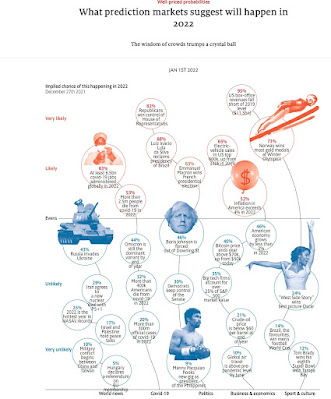
"For much of humanity the new year is a time for reflection on the past, The Economist says in another article. "But many minds will also inevitably cast forward. If the fitful past two years of the covid-19 pandemic offer any lesson, it is that the future remains murky and uncertain."

The article, which contains the image below, adds, "Not to be deterred, we have turned to prediction markets to give us a glimpse of 2022. Pooling data from punters on exchanges like Betfair, Metaculus, PredictIt and Smarkets, can offer a theoretically better guide to the future than plunging headlong into the unknown. Will the pandemic claim millions more? Might Russia invade Ukraine? Could America's high inflation persist? And will Tom Brady win an obscene eighth Super Bowl? Another eventful year awaits."


A business' success is often determined by how it can quickly adapt to changing circumstance cause by natural disasters, health crises, or financial market volatility, just to name a few. Defined as an ability to recover from or adjust easily to misfortune or change, resilience is a word that must be in the lexicon of all business leaders. As explained in a post on this forum about an article published by Dr. Linton Wells II, an expert who focuses on links between policy, technology and decision-making, especially in building resilience and cybersecurity, "Resilient companies produce impressive results. They have shown positive earnings and sales growth during recessionary years, improved their corporate image by effective strategic responses to natural disasters, raised dividends for several consecutive decades, and won back market share against low cost and online competitors."

While it is ideal to have more certainty on what may take place in the future, this is simply not possible. Whether it is for our home, business, or community,, the best we can do is prepare for uncertainty. There are events we can prepare for as evident in a video entitled "The World Ahead 2022: five stories to watch out for," but we must also create plans to quickly adapt to those unforeseen events.


Recognizing that the new normal has arrived, we should be asking: How can we ensure future-readiness by preparing for disruptions, be it a pandemic, natural disaster, geopolitical crisis, or a volatile financial market?

What are your predictions for 2022?

Aaron Rose is a board member, corporate advisor, and co-founder of great companies. He also serves as the editor of GT Perspectives, an online forum focused on turning perspective into opportunity.

December 29, 2021

While Mobile Technology Offers Life-Changing Benefits, Research Shows Many Persons With Disabilities Remain Unconnected and Digitally Excluded

According to a fact sheet produced by the World Health Organization (WHO), one billion people, or 15 percent of the global population, live with some form of disability. And the number of people living with disability are dramatically increasing due to demographic trends and increases in chronic health conditions, among other causes. In consideration of this information provided by the WHO, it was with great interest to read a report produced by the GSM Association (GSMA), a UK-based organization that represents the interests of mobile operators worldwide, that says "Mobile devices and services offer life-changing benefits to persons with disabilities, such as enabling access to basic services and independent living. Despite this potential many persons with disabilities remain unconnected and digitally excluded. It is estimated that around 90 percent do not have adequate access to the assistive technologies (AT) they require. Mobile-based ATs, especially smartphones, could be a valuable and cost-effective tool for persons with disabilities."

The report presents key insights into the mobile disability gap. Presenting research from the following seven low- and middle-income countries (LMIC): Algeria, Bangladesh, Guatemala, India, Kenya, Nigeria, and Pakistan, GSMA's research "revealed that persons with disabilities are less likely to own a mobile, especially a smartphone, and are even less likely to use, or be aware of, mobile internet."

In explaining the research's methodology, the GSMA says "The Washington Group Short Set of Questions was used to identify persons with disabilities. Respondents who reported that they had 'a lot of difficulty' or 'cannot do at all' in at least one of the functional domains were considered a person with disabilities revealed that persons with disabilities."

Key findings of the report include:
  1. "Persons with disabilities have lower levels of mobile ownership than non-disabled persons in all countries surveyed. Bangladesh has the widest gap, where persons with disabilities are 55 percent less likely to own a mobile phone than non-disabled persons, and the smallest gap is in Kenya and Pakistan at 11 percent.
  2. "Despite the life-enhancing potential of smartphones as an assistive technology and a gateway to digital inclusion, persons with disabilities are significantly less likely to own a smartphone than non-disabled persons. The disability gap in smartphone ownership is wider than the gap in overall mobile ownership in most of the survey countries.
  3. "There is a significant disability gap in mobile internet use. In each of the survey countries, persons with disabilities are significantly less likely to use mobile internet than non-disabled persons.
  4. "Across all survey countries, fewer persons with disabilities are aware of the mobile internet than non-disabled persons. This is a significant barrier that prevents persons with disabilities from using and benefitting from mobile internet.
  5. "In India and Pakistan, mobile users with disabilities who are aware of mobile internet but do not use it reported that a lack of literacy and skills is the main barrier to usage. Other major barriers include lack of perceived relevance, safety and security and affordability."

The GSMA correctly asserts that "Key stakeholders in the mobile industry have a critical role to play in closing the mobile disability gap and ensuring digital inclusion for all. This includes policymakers, international organizations, non-governmental organizations, organizations for persons with disabilities (OPDs), mobile operators and other ecosystem players, including start-ups and device manufacturers."

What is more, the report offers the following recommendations for stakeholders interested in eliminating the mobile disability gap:
  • "Understand the mobile disability gap and how to reach and serve persons with disabilities better. Accurate and reliable disability-disaggregated data is a crucial tool for stakeholders to understand and address barriers to the digital inclusion of persons with disabilities. However, in most markets, disability-disaggregated data related to the access and use of mobile-enabled products and services is lacking, and has hampered digital inclusion efforts. It is critical that policymakers, the public and private sectors and digital players invest in, and collaborate on, accurate, ethical and effective data collection. This will help to monitor progress and inform the design of inclusive and relevant products, services and innovations for persons with disabilities.
  • "Raise awareness of mobile internet and its benefits for persons with disabilities. Awareness of mobile internet is lower among persons with disabilities than non-disabled persons, limiting their potential usage of mobile internet. To raise awareness of the benefits of mobile internet and smartphones as an assistive technology, stakeholders can develop campaigns targeting persons with disabilities and explore partnerships with OPDs to reach persons with disabilities and showcase how mobile services are relevant to their lives.
  • "Develop inclusive products and services that meet the diverse needs of persons with disabilities. Once persons with disabilities are aware of mobile internet and its benefits, it is important that they have access to relevant products and services that meet their needs. It is important that stakeholders ensure that existing products are accessible, and that new content, products and services are created with persons with disabilities in mind (e.g. user-centered design and inclusive or universal design practices) to improve accessibility and usability.
  • "Build the digital skills of persons with disabilities. Many persons with disabilities are digitally excluded because they do not know how to use mobile and mobile internet in a way that meets their needs. Stakeholders can support the delivery of mobile digital skills programs that train persons with disabilities (and their caregivers/relatives) how to use mobile internet to meet their needs. They can also explore partnerships with OPDs or other relevant organizations to teach persons with disabilities how to access and use accessibility features and mobile-enabled products and services. Stakeholders can use resources such as the GSMA's Mobile Internet Skills Training Toolkit (MISTT) to train people how to access and use mobile internet services, including accessibility features. The toolkit is a visual, easy-to-follow guide that helps trainers demonstrate the functionality and value of the internet on internet-enabled mobile phones.
  • "Ensure products and services are affordable for persons with disabilities. Smartphones, which typically provide the most accessibility features and drive substantially higher mobile internet use, are often unaffordable for persons with disabilities. Mobile operators can design solutions to make internet-enabled handsets more affordable to persons with disabilities, such as innovative financing models and 'data-light' accessible versions of mobile apps and services."

A more detailed set of recommendations for the mobile industry can be found in the GSMA's Principles for Driving the Digital Inclusion of Persons with Disabilities.

Do you agree with the recommendations for eliminating the mobile disability gap? What inclusive products and services are you developing to meet the diverse needs of persons with disabilities?

Aaron Rose is a board member, corporate advisor, and co-founder of great companies. He also serves as the editor of GT Perspectives, an online forum focused on turning perspective into opportunity.

December 27, 2021

Japan: On the Front Line

Image: The Economist
Reflecting on my earliest childhood memories, Japan is a country outside of my home country of the United States that I first learned about. Starting with my grandfather sharing his experience of serving in the U.S. military at Pearl Harbor, Hawai'i on Dec. 7th, 1941 (an experience that does not reflect the east Asian country in a positive light), to my fourth grade teacher, Ms. Murakami, a Japanese-American who shared aspects of the country's unique culture, to summer visits to my grandfather's sister-in-law in Florida where Aunt Etsi taught me to say a few Japanese words and how to use chopsticks, I find the country fascinating.

During my professional career, I appreciate having the privilege of spending a significant amount of time in Japan. These experiences, some of which are discussed on this forum, include helping a Japanese medical device company create a strategic plan to export their product to key international markets, advising an American company to deploy its services in the country, or building relationships with business and government leaders from Kobe, Japan's only city to have a sister city relationship with Seattle. Therefore, it was with great interest to read a special report produced by The Economist about the world's third largest economy.

Accompanying the report, which is comprised of eight articles, an editorial notes that "Two takes are often told about Japan. The first is of a nation in decline, with a shrinking and ageing population, sapped of its vitality. The second is of an alluring, hyper-functional, somewhat eccentric society—a nice place to eat sushi or explore strange subcultures, but of little wider relevance to the outside world. Both tales lead people to dismiss Japan. That is a mistake."

The Economist's report argues that "Japan is not an outlier—it is a harbinger. Many of the challenges it faces already affect other countries, or soon will, including rapid ageing, secular stagnation, the risk of natural disasters, and the peril of being caught between China and America. The fact that some of these problems hit Japan early makes it a useful laboratory for observing their effects and working out how to respond."

The report begins by explaining that "Japan's new imperial era began in spring 2019, when a nondescript man in a dark suit revealed its name: Reiwa. The first character, rei, means 'auspicious' or 'orderly'; wa means 'harmony' or 'peace' (officials chose 'beautiful harmony' as the English rendering). For the first time the name came not from classical Chinese literature, but from Japan's Manyoshu poetry anthology, compiled over a millennium ago: 'In this auspicious (rei) month of early spring, the weather is fine and the wind gentle (wa).'"

With respect to Japan making a "case for a more active and interventionist security policy," The Economist points out that "If rivalry between China and America is the big story in 21st century geopolitics, no other country, except perhaps Taiwan itself, has as much influence as Japan over how it will unfold—nor as much to lose if it goes badly. 'Japan is the front line,' says General Yoshida Yoshihide, chief of the army. This reality is forcing a realization that, although there can be no substitute for America, Japan must supplement it in order to maintain a favorable balance of power."

Moreover, "Japan is strengthening defenses and building ties with others. Tanaka Akihiko, of the National Graduate Institute for Policy Studies (GRIPS) in Tokyo, speaks of a shift from a 'one-pillar' to a 'multi-pillar' architecture. 'We can't rely on America alone,' he says. That does not mean turning away but keeping America close by contributing more. Nor does it mean antagonizing China, upon which the economy depends. 'As the rest of us figure out how to compete with China without catastrophe, Japan has been there for at least a decade and Japan has the best strategy,' says Michael Green, a former official at America's National Security Council."

On the topic of climate change, Japan is prepared for disaster, but unprepared for climate change. "As the threat from natural hazards grows, from climate change-fueled fires to zoonotic pandemics, the world must live with more risk," says The Economist. "The countries that fare best will be the resilient ones. In 'The Resilient Society,' Markus Brunnermeier, an economist from Princeton University, argues that "Resilience can serve as the guiding North Star for designing a post-covid-19 society."

The discussion on climate change importantly adds: "The biggest lesson from Japan is the value of preparation." As Karashima Yukari, who works at the Peace Boat Disaster Relief Volunteer Center, a Tokyo-based nongovernmental organization that assists people in disaster-affected communities and strengthen the capacity of local communities to response to disasters both in Japan and around the world, says, "'It's too late if you start acting after the disaster happens.' That this sounds banal in much of the world makes its absence more striking."

What is more, "Of $137bn provided in global disaster-related development assistance from 2005 to 2017, 96% was spent on emergency response and reconstruction, less than 4% on disaster preparedness. Donors prefer high-profile rescue work; the media cover disasters when they happen, not when they do not. Many governments treat prevention as a cost, not an investment. But natural hazards are not always disasters. 'The hazard becomes a disaster when the coping capacity is too weak,' says Takeya Kimio, an adviser to Japan’s overseas development agency. In 2015 he promoted the 'Build Back Better' concept in the UN Sendai Framework, a global pact on disaster-risk management."

The special report also discusses how Tokyo, the world's biggest city, is also one of the most livable. "[W]ith 37m residents in the metropolitan area and 14m in the city proper," Tokyo "offers lessons to developing cities elsewhere. In 1950, 30% of the world's population was urban; by 2050, 68% will be. Much remaining growth will be in megacities of more than 10m in Asia and Africa. There are 33 such cities now; by 2030 there will be 43. As Tokyo grapples with what to do when cities age and shrink, it can also serve as a case study for other rich cities."

Japan is learning to cope with an ageing population, notes The Economist. "Demographic change has two drivers often lumped together: rising longevity and a falling birth rate. Their convergence demands 'a new map of life' says Akiyama Hiroko, founder of the University of Tokyo's Institute of Gerontology." Furthermore, "Infrastructure created when the population was younger and the demographic pyramid sturdier must be redesigned, from health care to housing to transport. The new reality demands a 'completely different way of thinking,' says Kashiwa Kazuyori, head of Gojome's town-planning department. When he started work in the 1970s, the focus was on growth. Now it is about managing decline."

Part of managing the decline of an ageing workforce is replacing retiring workers with foreign workers. Japan, perhaps unfairly, is often criticized about its reticence of allowing foreign workers to immigrate to the island nation. An article focused on how the ranks of foreign workers are growing fact but from a low base, however, says "One in every 55 workers is foreign, up from one in every 204 in 2009."

As for the economy, The Economist explains how "Japan is the canary in this coal-mine":
In the 1980s its booming economy struck fear in the world. After the bubble burst in the 1990s, public debt ballooned and deflation set in. Many in the West said Japan's debt was unsustainable and the Bank of Japan (BOJ) should do more to boost inflation. In 2013 the BOJ's governor, Kuroda Haruhiko, embarked on dramatic monetary easing. The debt hovered around 230% of GDP. A strange thing ensued: no fiscal crisis struck, nor did inflation come near the 2% target. "The standard textbook on macroeconomics needs an additional few chapters—it doesn't capture the problems Japan faced," says Shirakawa Masaaki, Mr Kuroda's predecessor.

Japan is among many countries that has experienced a decline of worker productivity. As the article on the economy explains, "Boosting productivity could help to offset the impact of the shrinking population." Yoshikawa Hiroshi, president of Rissho University in Tokyo, "reckons that innovation is key to growth, and that ageing creates new problems that entrepreneurs can solve. Generational shifts may help. While many still prefer stable sarariman (salaryman) jobs in big firms, some of today's brightest graduates go into startups." Encouragingly, I have observed a rise of Japanese startups in the past several years that are developing innovative solutions in artificial intelligence, climate tech, data analytics and machine learning, digital healthcare, robotics, and enterprise services.

The report concludes with an assertion that Japan "would be better with younger and more dynamic leaders." The ruling LDP party has won every election "but twice since the party's founding in 1955." The article importantly explains that "Without a threat of losing power, any ruling party becomes unaccountable. Demographic change exacerbates things: some 20% of local politicians are elected without a contest. The result is a government that, in many ways, does not look or think like its people. Less than 10% of new Diet members are women; just three out of 21 cabinet ministers are. Only two are under 50. Dynastic politicians still dominate."

What is more, "Society is changing faster than established powers. Japan is in the midst of a quiet transformation, argues Hosoya Yuichi, a political scientist: 'There is a new wind, but within an old-fashioned structure.' On social issues from gay rights to family law, the LDP is out of step. Many voters feel they cannot change the system, which drives some into business or civil society, not politics."

While attending a conference about Japan's importance in the future of Asia in 2016, I was asked by a fellow attendee about my thoughts on economic engagement in Japan. In light of China's rapidly growing economy at the time, coupled with Japan's secular stagnation of low inflation, low interest rates and low growth, I replied that a business would be foolish to consider entering the Japanese market. I was wrong.

Despite tightening regulations on the private sector, increased censorship of the media and Internet, inconsistent policies on currency repatriation, and issues concerning human rights, China's market may be too big for some businesses to ignore. Japan, however, with its independent judiciary, democratic government, and open economy, presents an opportunity that businesses of all sizes should explore.

Do you agree that Japan is a harbinger, not an outlier? What business or investment opportunities are you seeing in the country?
 
Aaron Rose is a board member, corporate advisor, and co-founder of great companies. He also serves as the editor of GT Perspectives, an online forum focused on turning perspective into opportunity.

December 26, 2021

Recommendations on Making Smart Cities and IoT a Reality in Latin America

In response to the previous post about Latin America's mobile economy including the projected growth of the region's Internet of Things (IoT) market, a reader shared a link to a report entitled Making smart cities and IoT a reality in Latin America: a quick guide for decision-makers. Noting that IoT "brings about an enormous opportunity for Latin America," the report, which was produced by the GSMA, a UK-based organization that represents the interests of mobile operators worldwide, predicts that "IoT solutions will innovate across a great variety of industries, such as energy, healthcare and transportation. They will combine communication networks and existing 'off-line' services increasing productivity, diminishing waste and improving citizens' wellbeing."

In addition, the report, which is available in English and español, explains that "[i]f governments and policymakers in Latin America want to realize the full benefits of the IoT and help close the technology gap between the region and developed countries they should take action, they should:
  • "Resist the temptation to consider IoT services as traditional telecom services. Legacy regulation – that is, regulations established long before the IoT became a reality to deal with traditional voice and data services, will be most often irrelevant, will unnecessarily stifle IoT innovation, slow down take up and ultimately damage consumer and business in the region
  • "Facilitate a cross-regulator, cross- department dialogue and strategy across the various government administrations. For example, utility and telecom regulators should define and work together on how to promote smart meters; Transport and Communication ministries should define together how communication networks will serve roads; Smart city planners from different towns should work together to define best practice and work on common standards."

On designing a comprehensive IoT policy, the GSMA recommends that policymakers "build a 3-step plan consisting of scoping the country's needs and potentials, estimating the positive impact on different economic areas and IoT verticals, and then designing and implementing specific actions to enable such growth." As for governments serving as demand enablers, the report suggests that "where possible, migrate towards utilizing IoT-enabled solution for public services – from utilities to urban mobility and healthcare." Developing public-private partnerships (PPPs) "and seeking/offering various sources of funding can be an important step to secure this goal."

Lastly, with respect to privacy, security, and standardization, the GSMA presents four recommends on how "governments should resist the temptation to create specific rules and national standards for IoT":
  • A general data protection law that applies horizontally to all industries and services – not just IoT – is an important measure to secure trust in the IoT and guarantee consistent levels of protection for users.
  • On what concerns security, it is important that governments support industry-led best practices and standards, which are constantly evolving to overcome threats, making it quicker and more cost-effective to adapt than rigid national standards.
  • Governments should also note the myriad of efforts already being pursued by industry-led standards, and their importance for interoperability of services at the national and international levels – therefore, creating national standards would likely be counterproductive.
  • A flexible and reliable governance structure. At the city level, it is important that mayors create a flexible governance model with an independent leader (such as a Chief Information Officer, CIO). For municipal services, mayors should always prefer scalable and interoperable solutions to avoid vendor lock-in. Finally, mayors should consider adopting open data policies to foster a data-enabled economy that could be easily used by citizens, NGOs and commercial entities. As well as providing one-stop access to a city's information, sharing data would support communication and analysis, more transparent and efficient policymaking, and create value by catalyzing the development of innovative apps and services.

As a topic of regular discussion on this forum, I remain optimistic by the benefits IoT and smart cities will bring to people in industrialize and emerging markets alike. International standards and best practices, however, must be in place to maximize the benefits of such innovation. I hope this report serves as a useful tool for policymakers in Latin America and emerging markets worldwide.
 
Do you agree with the recommendations on how to make smart cities and IoT a reality in Latin America? What would you add?

Aaron Rose is a board member, corporate advisor, and co-founder of great companies. He also serves as the editor of GT Perspectives, an online forum focused on turning perspective into opportunity.
December 13, 2021

Economic Contribution of Latin America's Mobile Ecosystem Will Grow by More Than $30 Billion by 2025

According to its GSMA Intelligence's latest report on the state of the mobile economy in Latin America, the research arm of the GSM Association (GSMA), a UK-based organization that represents the interests of mobile operators worldwide, says "The mobile industry in Latin America continues to play a crucial role in the response to Covid-19. Mobile networks have enabled social and economic activities to continue. People have relied on the internet to stay connected to friends and family, access educational and health services, and work remotely."

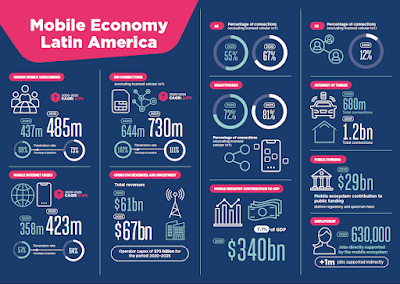
Growth in subscriber penetration and smartphone adoption remains strong, the report notes. GSMA Intelligence estimates Latin America will have 485 million unique mobile subscribers by 2025 (73% of the population), up from nearly 450 million by the end of 2021. "Around half of new subscribers will come from Brazil and Mexico during this period. There will also be strong growth in underpenetrated markets such as Guatemala and Honduras."

The report, which is available in English and español, importantly adds:
Smartphone connections in Latin America will reach 500 million at the end of 2021 – an adoption rate of 74%. The next four years will see almost 100 million additional smartphone connections in the region, taking adoption above 80%. This will spur mobile internet adoption, enabling more people to access digital services for the first time. These achievements will be underpinned by operators' continued investment in network infrastructure. Between 2020 and 2025, mobile operators in Latin America will invest more than $73 billion in their networks, with an increasing share of this 5G-related.
While 4G continues to dominate the Latin American market, accounting for close to 70 percent of total connections at the end of 2025, the report encouragingly asserts that "5G momentum is building, with further commercial 5G services launched in 2021." GSMA Intelligence points out that "While mobile operators wait for access to new spectrum, they are laying the groundwork for the 5G era through investments in accompanying infrastructure, such as fiber, and partnerships to trial and develop new applications."

On the topic of the mobile industry driving economic growth and social development, the report explains that "In 2020, mobile technologies and services generated 7.1% of GDP in Latin America – a contribution that amounted to more than $340 billion of economic value added." Moreover, "The mobile ecosystem also supported more than 1.6 million jobs (directly and indirectly) and made a substantial contribution to the funding of the public sector, with more than $29 billion raised through taxes on the sector in 2020. By 2025, the economic contribution of the Latin American mobile ecosystem will grow by more than $30 billion, as countries in the region increasingly benefit from the improvements in productivity and efficiency brought about by the increased take-up of mobile services."

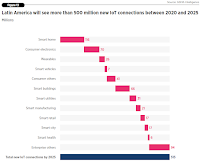
On the transformation of the enterprise sector, GSMA Intelligence says "As a result of mobile operator activity and partnerships, total IoT connections in Latin America will amass at a hastening pace, reaching close to 1.2 billion in 2025. Growth will be relatively faster in the enterprise IoT market, with a notable increase in the adoption of smart buildings solutions (forecast to record a CAGR of 24% between 2020 and 2025)." Furthermore, "IoT applications have the power to make a meaningful contribution to the UN's Sustainable Development Goals (SDGs) by facilitating carbon emissions reductions, while improving safety and supporting economic development."

Lastly, the report discusses decisions policymakers in Latin American can make to help shape the connected society. "The pandemic has emphasized the need for connectivity and the critical role of mobile technology. Now is the time for governments to reassess the business and regulatory environment for mobile services in order to accelerate investment and innovation for a connected society."

Infographic: GSMA Intelligence

What opportunities are you seeing in Latin America's mobile economy?

Aaron Rose is a board member, corporate advisor, and co-founder of great companies. He also serves as the editor of GT Perspectives, an online forum focused on turning perspective into opportunity.