Showing posts with label logistics. Show all posts

October 27, 2022

Korean Companies Demonstrate Their Innovative Tech Solutions at TechCrunch Disrupt 2022

TechCrunch Disrupt resumed its in-person event in San Francisco from Oct. 18th-20th, 2022. The conference's purpose is to bring together the global startup community to discover insights, collaborate, and celebrate achievements that have defined each founder's journey and for those yet to come in the future. At the invitation of the Korea Trade-Investment Promotion Agency (KOTRA), a state-funded trade and investment promotion agency operated by the South Korean government, I had the opportunity to visit the conference's Korea Pavilion and meet with startup founders and their colleagues. Among the 20 great companies that demonstrated their innovative products and services at the pavilion, which was co-hosted by the Korea International Trade Research Institute (KITRI), there are a few are worth mentioning based on my professional and personal interests (the program book containing a description of all 20 companies may be viewed here).

Cochl created an artificial intelligence (AI) platform specializing in ambient sound recognition. Use cases include public safety (faster response to shooting incidents, vandalism detection for buildings, and violence prevention by scream/yell monitoring), traffic monitoring (automatic car accident report and illegal car honking noise monitoring), and autonomous driving (ambulance and police car siren detection for giving right-of-way action and car window break monitoring). Another valuable use case is in the defense sector by using smart glasses with gunshot analysis, submarine and torpedo type analysis, and surrounding environment monitoring with unmanned ground vehicles.

Dabeeo provides global geospatial information based on AI/ML (machine learning) technology by reading and interpreting the earth to help customers build or modify digital maps. Its STUDIO for maps is a SaaS platform that makes creating, editing, and managing map data convenient and intuitive to use. This website provides several examples of how retailers, showrooms, factories, stadiums, and exhibition centers are using the cloud-based platform.

TheWaveTalk developed a technology that uses laser multi-scattering and deep learning to measure foreign substances in water with great precision. Through the technology, they developed a home water quality meter called the WaTalk, which scatters light inside the water using a laser and analyzes small signals of fine particles such as bacteria, virus, organic pollutants, and microplastics to determine the degree of contamination. The company says its product is 20-50 times cheaper than professional measuring equipment.


Image: Willog
Willog
 is simplifying the complex cold chain industry. (A cold chain is a low temperature-controlled supply chain network.) The company's patent-based monitoring device collects various data during the entire logistics process, and displays it on a QR code. Willog's data monitoring device, the One Time QR (OTQ), which can be placed on vehicles, shipping containers or pallets, allows instant confirmation of temperature records by scanning the QR code with a smartphone camera and does not require other training or equipment. Effective field operation response is possible without extra time or procedures spent between the driver and the personnel to check the temperature. Where the device cannot be physically retrieved, Willog's OTQ-N uses near-field communication (NFC) to facilitate logistics monitoring within a flexible environment.

While KOTRA provides a useful service in the promotion of trade and investment with 128 Korea Business Centers located in 84 countries, the agency also facilitates global people-to-people exchange and technological exchange. I appreciate having the opportunity to meet with ambitious startup leaders who are building companies that improve the way we live, work, and play.


Aaron Rose is a board member, corporate advisor, and co-founder of great companies. He also serves as the editor of GT Perspectives, an online forum focused on turning perspective into opportunity.

March 3, 2022

How to Reduce Africa's Reliance on Commodities

"Despite being home to 17% of the world's population, Africa is an underinvested market," a newsletter published by Morgan Stanley, a financial services firm, says. The newsletter also points out that "72% of investors surveyed do not currently invest there. We believe that despite near-term challenges, the continent offers compelling long-term opportunities vis-à-vis private markets and infrastructure."

Moreover, "Africa's median age, at 19.7, is considerably lower than those of Asia and South America, at 32.0 and 32.1, respectively. Furthermore, according to the World Economic Forum, Africa is expected to have the world's largest working-age population by 2034. The expected increase in the working-age population will likely promote middle class growth, building on trends already in place."

As an investor and entrepreneur, I appreciate how these statistics represent future opportunities. However, as an advisor to several officials representing African nations, I wish these leaders understood the importance of these statistics and the opportunity that exists for the citizens they represent. In my conversations with African government officials, I am often asked for my opinion on how to attract foreign direct investment to grow their private sector. While I strongly advocate for establishing policies and making investments to build a thriving digital economy in Africa, these officials mistakenly focus our conversation on how to increase their overdependence on raw materials and commodities such as minerals, oil, gas, and lumber.

Even The Economist notes that "many African economies have relied too much on raw materials for too long." The article further explains that "The UN defines a country as dependent on commodities if they are more than three-fifths of its physical exports. Fully 83% of African countries meet that threshold, up from 77% a decade ago. Some depend on produce such as tea, but most rely on mining or on pumping oil. When commodities crashed in 2015, foreign direct investment (FDI) and growth tumbled and have yet to fully recover."

The article importantly adds: "Broad averages obscure some of the progress that has been made to diversify economies. Over the past decade resources have become less important to GDP. The share of commodities in goods exports from the continent as a whole has fallen, too. And in countries such as Botswana and Malawi, services have grown strongly. Even manufacturing is rebounding."

However, "Africa has a long way to go if it is to break free of the resource curse. In countries rich in diamonds or oil, political power can be a license to loot. So unscrupulous folk are tempted to grab and hang on to it by any means available. Resource-rich countries are more likely to suffer dictatorships, and also tend to have more and longer civil wars."

Building a thriving economy while strengthening government institutions with better transparency and will require investments in education and infrastructure. Using Sierra Leone as an example, The Economist says the west Africa nation "now spends about 21% of its budget on education, up from 13% in 2017. As a result, more youngsters are passing their final exams than ever before. Mining began in Sierra Leone about a century ago. 'If we had invested in humans for a hundred years,' sighs David Moinina Sengeh, the education minister, 'we would be in a much better place today.'"

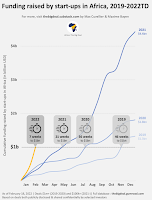
While I agree with the authors of Morgan Stanley's newsletter that many investors are missing out on lucrative opportunities in Africa, there is evidence this is changing. As reflected in the chart at the top of this post, African startups raised $4.4 billion in 2021, which was more than 2.5 times the amount raised in the previous year, according to "Africa: The Big Deal," a website managed by Max Cuvellier and Maxime Bayen.

With respect to specific sectors, fintech startups raised $2.3 billion from investors last year (see chart below). While this sector captured 53% of funds raised, other key sectors such as energy, retail, healthcare, education, and logistics and transportation are also on the rise.


I do not completely believe the notion that institutional investors in America or Europe are investing in African startups because they see the market as a great investment opportunity. Their investment is a result of chasing higher yields since the average junk-bond yields in America and Europe are 5.1% and 3.3%, respectively, well below inflation. And while there is good reason to cheer the recent increases in investments on the continent and the revenues some of these startups are reporting, I am still waiting for announcements of profitability and successful exits through an initial public offering or acquisition. Nevertheless, as someone who has supported tech startups in Africa for over 20 years, I am optimistic that the trend in the number of investors, amount raised, and overall number of startups on the continent will continue to grow for years to come.

I look forward to future conversations with government leaders in Africa on how to reduce their reliance on commodities by investing in education and infrastructure. Such investments will only help their growing working-age population enjoy the fruits of a middle-class lifestyle.

What opportunities and risks are you seeing in Africa's startup ecosystem?

Aaron Rose is a board member, corporate advisor, and co-founder of great companies. He also serves as the editor of GT Perspectives, an online forum focused on turning perspective into opportunity.

November 13, 2020

UNCTAD Report on Maritime Trade Presents Six Policy Actions to Be Taken in Response to the COVID-19 Pandemic

Until the global spread of the coronavirus disease (COVID-19) pandemic earlier this year, most consumers worldwide never considered how the toilet paper or baking goods they purchase arrive on the shelves of their local grocer. Reports about disrupted supply chains, reduced cargo volumes, and shortage of healthy workers at seaports in distance lands, which normally are found in specialized news sources, started to appear in the mainstream media as the COVID-19 began to impact the global economy. Even if they did not comprehend its specific nuances, people took notice of the role maritime transport has on transporting their home goods to a regional distribution center for ordering via an e-commerce platform. And these consumers quickly began to understand disruptions in the maritime transport industry has a direct impact of obtaining goods they rely on purchasing with ease.

I have long been interested in the logistics industry starting with a tour of a local post office during my childhood where I learned how a letter dropped in the corner letter box is delivered to a friend who lived a few blocks away or my grandparents hundreds of miles from my residence. And I was enthralled by the massive cargo ships docked at the Port of Seattle when I moved to the Pacific Northwest in the 1990s. As a member of board of advisors of TRInternational, Inc., a Seattle-based chemical distributor, which imports many products into the United States via cargo ships, I closely follow the maritime transport industry. Therefore, I took a great interest in reading the Review of Maritime Transport 2020, a recurrent publication prepared by the United Nations Conference on Trade and Development (UNCTAD) secretariat since 1968 with the aim of fostering the transparency of maritime markets and analyzing relevant developments.

Structured around five substantive chapters, the report explains that the "pandemic has brought to the fore the importance of maritime transport as an essential sector for the continued delivery of critical supplies and global trade in time of crisis, during the recovery stage and when resuming normality." What is more, "The global health and economic crisis triggered by the pandemic has upended the landscape for maritime transport and trade and significantly affected growth prospects. UNCTAD projects the volume of international maritime trade to fall by 4.1 percent in 2020. Amid supply-chain disruptions, demand contractions and global economic uncertainty caused by the pandemic, the global economy was severely affected by a twin supply and demand shock." Encouragingly, "UNCTAD projections indicate that maritime trade will recover in 2021 and expand by 4.8 percent."

On the topic of cybersecurity, "Increased cyberattacks in shipping during the COVID-19 crisis were exacerbated by the limited ability of companies to sufficiently protect themselves, including because of travel restrictions, social distancing measures and economic recession." Moreover, "With ships and ports becoming better connected and further integrated into information technology networks, the implementation and strengthening of cybersecurity measures are becoming essential priorities."

New International Maritime Organization (IMO) "resolutions encourage administrations to ensure that cybersecurity risks are appropriately addressed in safety-management systems. Owners who fail to do so are not only exposed to such risks but may have their ships detained by port State control authorities that need to enforce this requirement. Cybersecurity risks are likely to continue to grow significantly as a result of greater reliance on electronic trading and an increasing shift to virtual interactions at all levels. This deepens vulnerabilities across the globe, with a potential to produce crippling effects on critical supply chains and services."

The report also presents "six priority areas for policy action to be taken in response to the COVID-19 pandemic and the persistent challenges facing the maritime transport and trade of developing countries":

1. Support trade so it can effectively sustain growth and development.

"Trade tensions, protectionism, export restrictions, particularly for essential goods in times of crisis, bring economic and social costs. These should, to the extent possible, be avoided. Further, non-tariff measures and other obstacles to trade should be addressed, including by stepping up trade facilitation action and customs automation."

2. Help reshape globalization for sustainability and resilience.

"Disruptions caused by the COVID-19 outbreak have re-ignited the debate on the risks associated with international manufacturing production and extended supply chains. It will be important to carefully assess the varied options when it comes to changes in supply-chain design and outcomes that are aligned with the Sustainable Development Goals and the 2030 Agenda for Sustainable Development. For example, a shortening of supply chains through reshoring or near shoring may reduce transport costs and fuel consumption, but it does not necessarily future-proof supply chains against disruptions that could take place, regardless of the location. Multi-sourcing approaches may guarantee greater resilience than approaches that concentrate production in a single location, whether at home or abroad. The debate on globalization should focus on identifying ways in which unsustainable globalization patterns could be mitigated to generate more value to a wider range of economies."

3. Promote greater technology uptake and digitalization.

"Polices should support a digital transformation that improves the resilience of supply chains and their supporting transportation networks. For maritime transport to play its role in linking global economies and supply chains, it should leverage the crisis by investing in technology and adopting solutions that meet the needs of the supply chains of the future and support resilience efforts. Digitalization efforts should enable enhanced efficiencies, including energy efficiency, and productivity in transport (for example, smart ports and shipping). It should also help countries tap e-commerce capabilities and transport facilitation benefits that boost trade. For more impact, cybersecurity should be strengthened
at all levels."

4. Harness data for monitoring and policy responses.

"The use of fast-evolving data capabilities can support efforts to forecast growth and monitor recovery trends. New sources of data and enhanced possibilities emanating from digitalization provide ample opportunities to analyze and improve policies. The pandemic has highlighted the potential for real-time data on ship movement and port traffic, as well as information on shipping schedules to generate early warning systems for economic growth and seaborne trade."

5. Enable agile and resilient maritime transport systems.

"There is a need to invest in risk management and emergency response preparedness beyond pandemics. Future-proofing the maritime supply chain and risk management require greater visibility of door-to-door transport operations. To do so, it is necessary to formulate plans setting out key actions and protocols to be implemented in response to crises while ensuring business continuity. Special consideration is needed to address seafarers' concerns, most of whom come from developing countries. Collaboration across port States and among different actors within countries remains key to improving crew changeover processes and ensuring standardized procedure and risk management protocols."

6. Maintain the momentum on sustainability, climate-change adaptation and resilience-building.

"Current efforts to deal with carbon emissions from shipping and the ongoing energy transition away from fossil fuels should remain a priority. Governments could direct stimulus packages to support recovery while promoting other priorities such as climate-change mitigation and adaptation action. Thus, policies adopted in the context of a post-pandemic world should support further progress in the shipping industry's transition to greening and sustainability. Meanwhile, sustainability and resilience concerns, such as connectivity among small island developing States and climate-change adaptation, remain key priorities. In these States, critical coastal transport infrastructure is a lifeline for external trade, tourism, and food and energy security. The generation and dissemination of tailored data and information plays an important role in risk assessment, the improvement of connectivity levels, the development of effective adaptation measures, the preparation of targeted studies and effective multidisciplinary and multi-stakeholder collaboration. In addition, progress towards the realization of target 8.1 of the Sustainable Development Goals – sustainable economic growth in the least developed countries – is ever more important to strengthen the resilience of the least developed countries and their ability to cope with future disruptions."

I concur that the "COVID-19 pandemic is a litmus test, not only for globalization but for global solidarity and collaboration as well. The success of the above-mentioned policy measures will depend on effective international collaboration to ensure coordinated policy responses. Coordinated efforts are also necessary for the standardization of data, tracking of port performance and development of protection mechanisms against cybercrime."

Lastly, "In facing the challenges ahead, policymakers should ensure that financial support, technical cooperation and capacity-building are provided to developing countries, in particular the most vulnerable groups of countries, including the least developed countries, landlocked developing countries and small island developing States."

Do you agree with the six policy actions to prepare for a post-pandemic world? Which cybersecurity tools and strategies should companies in the maritime trade industry employ to combat cybercrime?

Aaron Rose is a board member, corporate advisor, and co-founder of great companies. He also serves as the editor of GT Perspectives, an online forum focused on turning perspective into opportunity.

June 21, 2018

Blockchain Can Drive Efficiency and Enable New Business Models in Global Logistics Industry

An online search for 'blockchain' will yield hundreds of articles. While the breadth and depth of these articles are wide-ranging, it is generally agreed that blockchain will become ubiquitous in many sectors including but not limited to financial services, insurance, healthcare, retail, and logistics and supply chain management. My colleagues and I are making significant efforts to better understand how blockchain works and ways it will improve business efficiency.

While many people are hearing the word 'blockchain' more often, very few understand how it works. Arjun Kharpal, a technology correspondent for CNBC, wrote an article on June 18, 2018 entitled "Everything you need to know about the blockchain," Mr. Kharpal begins explaining blockchain by how it "works with bitcoin" and then "see how the technology can be transferred to many other real-world use cases." With respect to supply chain management, Mr. Kharpal says, "Blockchain technology can also be used to track products across a supply chain or route. For example, diamond producer De Beers recently announced that it had trialed the technology to trace the stones from the time they were mined to delivering them to a jeweler. The blockchain can also be used to track ownership of assets such as fine art of even property."

DHL, a global logistics company, through its Customer Solutions & Innovation division, published a report entitled Blockchain in Logistics, which provides perspectives on the upcoming impact of blockchain technology and use cases for the logistics industry. Produced in cooperation with Accenture, a management consulting company, the report aims to answer:
  1. What is blockchain and what are the key challenges?
  2. How is this technology already being applied across industries?
  3. What opportunities could blockchain deliver to your logistics operations?

In addition to the aforementioned article by Mr. Kharpal, the DHL report provides a concise definition of blockchain as "a distributed ledger technology that can record transactions between parties in a secure and permanent way. By 'sharing' databases between multiple parties, blockchain essentially removes the need for intermediaries who were previously required to act as trusted third parties to verify, record and coordinate transactions. By facilitating the move from a centralized to a decentralized and distributed system (see figure 1), blockchain effectively liberates data that was previously kept in safeguarded silos."

Key challenges facing blockchain technology include:

"Gaining industry adoption is the most critical challenge and this will determine the success of blockchain technology in logistics. Being able to accurately and safely exchange information within a community is a key advantage of blockchain and stakeholders benefit the most when their community contains many relevant members. Therefore, similar to Facebook, the value of the community increases when it is adopted by a growing number of relevant stakeholders."

"It is necessary to make progress with blockchain technology itself in order to overcome current technical limitations. This is especially required for companies moving from a pilot implementation to full-scale deployment. For example, some blockchain implementations have been known to scale poorly and suffer from high latency although new innovations are being developed to address these scalability and performance issues."

"Organization and culture play a significant role in the success of digital transformation in any industry. Particularly with blockchain technology, this cannot be overlooked as its adoption will require a collaborative mindset to engage with a large number of stakeholders. Therefore, within
organizations, a culture of embracing new opportunities from blockchain technology should be fostered. Managers, particularly those in IT functions, must gain blockchain expertise to proactively push organizational exploration and, if applicable, adoption of blockchain-based solutions."

The report importantly notes, "While there are many hurdles to overcome, these challenges with blockchain are not insurmountable. Already this technology, despite its relative infancy, is showing promise across a wide range of industries including citizen services, retail, life sciences and healthcare, automotive, manufacturing, energy, and logistics."


Specifically to logistics, the report says "global supply chains are highly complex, with diverse stakeholders, varying interests, and many third-party intermediaries – challenges that blockchain is well suited to address. In the logistics industry, blockchain can be harnessed in two key ways, namely, to drive efficiency and enable new business models:

"Drive efficiency: Blockchain can potentially improve efficiency in global trade by greatly reducing bureaucracy and paperwork. For example, a multi-stakeholder process with a lengthy paper trail could be replaced with an automated process storing information in a tamper-evident digital format.

"Another example is the automation of services that currently require an intermediary such as insurance, legal, brokerage, and settlement services. Blockchain could be used to track a product's lifecycle and ownership transfer from origin to store shelf, even as it changes hands between the manufacturer, logistics service provider, wholesaler, retailer and consumer. It would facilitate and automate each business transaction, enabling a more direct relationship between each participant (e.g., automating payments and transferring legal ownership between parties).

"Enable new business models: Micro payments, digital identities, certificates, tamper-proof documents and much more can be introduced and radically improved using blockchain-based services. For example, driver training organizations could replace easy-to-fake paper-based certificates with tamper-proof digital versions that can then lead to new identity-related services. Just as the Internet began a revolution of communication, blockchain technology could disrupt current business practices and models."

Lastly, the report encouragingly explains, "Blockchain technology is emerging from its first deployments in cryptocurrency and is now likely to have significant impact across almost all industries. Like a pebble dropped into a lake, the ripples from this technology are beginning to expand outwards in all directions including the logistics industry, where blockchain promises to make business processes more efficient and facilitate innovative new services and business models."

How will your organization utilize blockchain technology?

Aaron Rose is an advisor to talented entrepreneurs and co-founder of great companies. He also serves as the editor of Solutions for a Sustainable World.