Showing posts with label West Africa. Show all posts

October 9, 2024

Toolkit Designed to Help Deliver Digital Skills Training for Impact in Sierra Leone

In my experience working in emerging and developing countries, many people mistakenly assume that if an individual is connected to the mobile internet, then they are able to utilize various life-enhancing applications. However, there is a stark difference between having access to the applications and the knowledge to make full use of these digital tools.

According to a report published by GSMA, "Mobile networks are the primary – and often only – channel for people to connect to the internet, especially in low-and-middle income countries (LMICs)." What is more, "Despite the rapid growth in mobile internet adoption in recent years, there remains a significant usage gap in LMICs: 48% of the population across LMICs still do not use the mobile internet. Of this group, 42% live within the footprint of a mobile broadband network but are not using the internet – this is known as the 'usage gap.' In Sierra Leone, the usage gap is significantly higher at 77%. Among people in this group, a lack of digital skills is one of the most significant barriers preventing them from adopting the mobile internet."

To address the digital skills barrier, the UK-based organization, which aims to unify the mobile ecosystem to discover, develop and deliver innovation foundational to positive business environments and societal change, says it "developed the Mobile Internet Skills Training Toolkit (MISTT), a free-to-use set of resources covering the fundamentals of the mobile internet, popular apps and use cases." The report also points out that "In order to gather evidence on the efficacy of the MISTT and identify potential areas for further improvements, the GSMA evaluated a digital skills training campaign conducted by Orange Sierra Leone, using MISTT. Specifically, the evaluation aimed to understand how effectively the MISTT delivers improved digital skills, what the socioeconomic impact is on trainees, and what improvements are needed to better reach the underserved."

Below are the report's key findings:
  • "MISTT improved digital skills for the majority of trainees interviewed in Sierra Leone, by reducing the functional barriers to mobile internet use, boosting learners' self-confidence and sense of independence and increasing the frequency of internet use by the trainees."
  • "There are indications that MISTT has had a positive socio-economic impact in Sierra Leone. This was visible in two main ways: enhancing trainees' potential to conduct business online has improved their prospects and income; and trainees have acquired greater knowledge and education across diverse topics."
  • "The impact of MISTT training on business was most observable for women, as they experienced the greatest changes to their digital skills confidence levels, as well as day-to-day life benefits, including being able to do business online while at home. Women were also more likely to enjoy the spill-over effects of the training, as their spouses passed on what they had learned."
  • "Incentives are a critical part of digital skills training – both for potential customers and trainers. The effectiveness of digital skills training can be greatly enhanced by providing appropriate incentives to potential trainees and their trainers. For trainers, this might involve providing financial incentives for the delivery of training that drives digital inclusion. For customers, this involves emphasizing how the mobile internet can be valuable to their lives and making them aware of any incentives, such as free mobile data and lunch, that are available to reward participation at in-person training events."
  • "Face-to-face training provides numerous advantages for the underserved. Face-to-face or in-person training allows a more tailored learning experience with opportunities for practical application by learners. For example, in-person training enabled trainers to spend time answering trainees' questions and providing tailored support on some of the challenges that they encounter. This is most important for learners with lower literacy and education levels, as well as those in rural areas. However, while effective, in-person training may be more costly for implementers and more difficult to scale."
  • "Digital skills training needs to consider the specific barriers that underserved users face. Issues, such as lower levels of education and a lack of basic digital skills and confidence, can impact on people's ability to access and participate in training activities. The evaluation also highlights the importance of adopting a gender lens to the delivery and expansion of digital skills training to ensure it is reaching women. There is a need to consider who might be excluded or disadvantaged from the proposed delivery approach, as well as ensuring the location, timing and content of the training, for instance, will meet their needs."
  • "To enhance the scalability and viability of MISTT digital skills training, implementers can explore other approaches to delivering digital skills beyond in-person channels to understand their effectiveness. Remote channels, for example videos, voice messaging and radio broadcasts, may provide an effective way for delivering digital skills training and/or improving training awareness in a cost-effective manner. Both in-person and remote channels have relative advantages and disadvantages. While in-person channels may be more effective at reaching certain population segments, remote channels provide unique benefits to implementers as they are easier to scale and can be iterated or updated more easily than face-to-face channels. Depending on the training objectives, both digital and in-person channels can be used simultaneously to complement the other."
  • "Combining digital skills training with other events or product pitches can extend the reach of digital skills training for the underserved and offer benefits to implementers. Delivering digital skills training alongside other activities, such as entertainment events or with the sale of a product or service, can encourage wider participation by reaching people who may be reluctant to attend a formal training event, for example, or linking it to something that is seen as relevant to them. Nonetheless, it's important to bear in mind the needs of underserved groups while designing these activities. For example, for women, the idea of 'standing in the street watching entertainment' may not feel culturally appropriate, as many are worried about theft or appearing to be lazy people who have nothing important to do."

I appreciate how GSMA's report "highlights the key learnings from the evaluation of the MISTT digital skills training initiative implemented by Orange Sierra Leone. It provides key insights on the effectiveness of MISTT in improving digital skills acquisition among different underserved groups, as well as the socio-economic impact of the training." There is also value in how the report "identifies considerations for improving the effectiveness of digital skills training in reaching underserved groups." Importantly, however, the GSMA notes that "the insights and recommendations in this report do not represent our comprehensive view of how to implement MISTT. Rather, they are recommendations specifically arising from this evaluation, and can be a basis for further research and trial. This complements our existing research on digital skills and evaluation of MISTT implementations."

What are your recommendations on how to promote digital literacy and reduce the digital usage gap in LMICs?

Aaron Rose is a board member, corporate advisor, and co-founder of great companies. He also serves as the editor of GT Perspectives, an online forum focused on turning perspective into opportunity.

February 26, 2024

Representatives From Nigeria's and Ghana's Financial Sector Learn About U.S. Cybersecurity Solutions

Sponsored by the U.S. Trade and Development Agency (USTDA), which helps companies create U.S. jobs through the export of U.S. goods and services for priority infrastructure projects in emerging economies, I attended the "Nigeria and Ghana Financial Sector Cybersecurity Solutions Networking Lunch" in San Francisco, Calif. on February 13th, 2024. This event, which was part of USTDA's Nigeria and Ghana Financial Sector Cybersecurity RTM (reverse trade mission), provided an opportunity for U.S. companies to hear firsthand from the delegation of Nigerian and Ghanaian business leaders about upcoming business opportunities and to meet one-on-one with delegates to present their cybersecurity services and solutions.

The delegation was interested in procuring products, technologies, and services from American businesses in the following areas: cyber resilience and risk management systems, electronic payments and digital processing, threat intelligence and fraud prevention, and network monitoring and data protection. I had engaging discussions with the delegates about the state of financial services sector in west Africa, the growing threat of cybersecurity, and efforts being made to train the local population to tackle the challenges and seize the opportunity to digitalize Africa's economy.

As an observer of the digitalization of the African continent, this event carried significant importance in light of the Digital Transformation with Africa (DTA) initiative, which President Joe Biden launched to expand digital access in Africa and increase commercial engagement between U.S. and African companies, support increased digital literacy, and strengthen digital enabling environments across Africa. The DTA channels the collective efforts of U.S. and allied government and private sector partners to advance these aims across three pillars including digital economy and infrastructure, human capital development, and digital enabling environment.

The DTA is part of USTDA's Access Africa initiative which supports quality information and communications technology (ICT) infrastructure across Africa. By working with the public and private sectors across the continent, Access Africa brings together critical stakeholders and designs targeted programming to advance inclusive, secure and sustainable connectivity. In addition, Access Africa partners individually contribute to the identification and implementation of USTDA activities that support Africa's ICT sector, including technical, regulatory, institutional and procurement assistance. Lastly, Access Africa provides lasting framework for Africa's public and private sector to partner with trusted U.S. providers and establish ICT relationships that are built to last.

According to the USTDA, as a leading developer and deployer of cybersecurity and data protection solutions, the U.S. private sector is well-positioned to become an essential partner in fortifying network infrastructure in emerging economies' financial sectors. U.S. firms are at the forefront of network monitoring, data analytics, vulnerability detection, artificial intelligence, and blockchain applications. Across Africa, the banking sector has been heavily targeted by cybercrime, with losses of $248 million to malicious cyber activity in 2021.

I appreciate how USTDA's Nigeria and Ghana Financial Sector Cybersecurity RTM allowed public and private sector decision-makers the opportunity to meet with U.S. entities engaged in developing and deploying cybersecurity solutions in the financial sector; establishing policies and regulations; and implementing best practices. The delegates learned about innovative U.S. technologies, financing mechanisms, and best practices to combat cybercrime in the banking sector.

Aaron Rose is a board member, corporate advisor, and co-founder of great companies. He also serves as the editor of GT Perspectives, an online forum focused on turning perspective into opportunity.

May 1, 2022

How to Improve Women's Use of Mobile Money in Ghana

"In Sub-Saharan Africa, women are 13 percent less likely than men to own a mobile phone; while 75 percent of women own a mobile, 74 million remain unconnected," says a report published by the GSMA. What is more, "In low- and middle-income countries (LMICs), where people are less likely to have formal bank accounts, mobile money is critical to facilitating widespread financial inclusion. ... While wider coverage and mobile ownership is making mobile money more accessible and relevant in people's everyday lives, a persistent gender gap is leaving women behind."

The GSMA explains that its "report focuses on the mobile money user journey in Ghana, highlighting the impact of COVID-19 on mobile money usage for men and women and the barriers to greater usage, with a specific focus on women entrepreneurs." The report's findings "highlight that beyond the high level numbers, women entrepreneurs lag behind in their awareness and usage of the non-core mobile money services in Ghana, which could add value to their businesses."

Below are the report's key findings:
  1. The COVID-19 pandemic has accelerated the adoption of mobile money services among men and women in Ghana.
  2. Mobile money is transitioning from an everyday cash replacement to a true banking alternative, but women entrepreneurs tend to use a narrower range of services than men.
  3. Most male and female mobile money users anticipate that they will use mobile money as often, if not more, in a post-COVID world.
  4. There are opportunities to increase awareness and use of mobile money services beyond payments, particularly among women entrepreneurs.
  5. Women, including entrepreneurs, need more support from others to learn about and use mobile money.
  6. Sustaining mobile money usage among new male and female users who signed up during the COVID-19 pandemic will require overcoming some additional barriers.

The GSMA points out that "Ghana is one of the most mature mobile money markets in the world and, despite having relatively low levels of gender equality, progressive policy and regulatory reforms have improved financial inclusion for men and women since the COVID-19 pandemic." However, as the findings in the report highlight, "that beyond the high level numbers, women entrepreneurs lag behind in their awareness and usage of the non-core mobile money services in Ghana, which could add value to their businesses."

The report importantly adds: "Users who adopted mobile money during the pandemic are less likely than longer term users to be aware of, and use, the full range of services available to them. Since they depend more heavily on agents and family to use their account and are less likely to handle transactions themselves, these users will need additional, on-going support."

To help provide users with on-going support, the report presents the following recommendations:
  1. "As life returns to normal, ensure that men and women who signed up for mobile money during the COVID-19 pandemic have the knowledge and skills they need to continue using it. This group currently lags behind longer term users in terms of knowledge and use of mobile money. As Ghana starts to recover from the pandemic, it is crucial that new users are given clear and accurate information on the benefits of using mobile money longer term. This will help ensure that usage expands and becomes entrenched in day-to-day life, not just during the COVID-19 pandemic.
  2. "Drive usage by increasing women's awareness of the range of mobile money services available. While there is almost no gender gap in account ownership in Ghana, women use a narrower range of mobile money services than men. It is clear that the experiences of men and women differ. For entrepreneurs, this is especially evident in the awareness of non-core mobile money services. Lower awareness is mirrored by lower usage – increasing knowledge through marketing and other approaches aimed at women and women entrepreneurs is likely to lead to greater uptake of a wider selection of mobile money services.
  3. "Improve women's understanding of mobile money to reduce their reliance on others. Women, including women entrepreneurs, are significantly more likely than men to rely on others when learning to use mobile money. Without concerted efforts to reduce women’s reliance on others, this is likely to limit the way they engage with the service, including the range of services they use and the frequency of usage. More needs to be done to provide training resources to women signing up to mobile money to ensure the information they receive is comprehensive and correct. For example, mobile money providers could incentivize agents to provide hands-on support to women to demonstrate how the service works and improve their confidence in using it. Supporting women to use the full range of mobile money services independently is likely to deliver more substantial benefits to women, and women entrepreneurs in particular, as well as higher revenues for the mobile industry."

What are you recommendations for improving women's use of mobile money in Ghana?

Aaron Rose is a board member, corporate advisor, and co-founder of great companies. He also serves as the editor of GT Perspectives, an online forum focused on turning perspective into opportunity.

March 3, 2022

How to Reduce Africa's Reliance on Commodities

"Despite being home to 17% of the world's population, Africa is an underinvested market," a newsletter published by Morgan Stanley, a financial services firm, says. The newsletter also points out that "72% of investors surveyed do not currently invest there. We believe that despite near-term challenges, the continent offers compelling long-term opportunities vis-à-vis private markets and infrastructure."

Moreover, "Africa's median age, at 19.7, is considerably lower than those of Asia and South America, at 32.0 and 32.1, respectively. Furthermore, according to the World Economic Forum, Africa is expected to have the world's largest working-age population by 2034. The expected increase in the working-age population will likely promote middle class growth, building on trends already in place."

As an investor and entrepreneur, I appreciate how these statistics represent future opportunities. However, as an advisor to several officials representing African nations, I wish these leaders understood the importance of these statistics and the opportunity that exists for the citizens they represent. In my conversations with African government officials, I am often asked for my opinion on how to attract foreign direct investment to grow their private sector. While I strongly advocate for establishing policies and making investments to build a thriving digital economy in Africa, these officials mistakenly focus our conversation on how to increase their overdependence on raw materials and commodities such as minerals, oil, gas, and lumber.

Even The Economist notes that "many African economies have relied too much on raw materials for too long." The article further explains that "The UN defines a country as dependent on commodities if they are more than three-fifths of its physical exports. Fully 83% of African countries meet that threshold, up from 77% a decade ago. Some depend on produce such as tea, but most rely on mining or on pumping oil. When commodities crashed in 2015, foreign direct investment (FDI) and growth tumbled and have yet to fully recover."

The article importantly adds: "Broad averages obscure some of the progress that has been made to diversify economies. Over the past decade resources have become less important to GDP. The share of commodities in goods exports from the continent as a whole has fallen, too. And in countries such as Botswana and Malawi, services have grown strongly. Even manufacturing is rebounding."

However, "Africa has a long way to go if it is to break free of the resource curse. In countries rich in diamonds or oil, political power can be a license to loot. So unscrupulous folk are tempted to grab and hang on to it by any means available. Resource-rich countries are more likely to suffer dictatorships, and also tend to have more and longer civil wars."

Building a thriving economy while strengthening government institutions with better transparency and will require investments in education and infrastructure. Using Sierra Leone as an example, The Economist says the west Africa nation "now spends about 21% of its budget on education, up from 13% in 2017. As a result, more youngsters are passing their final exams than ever before. Mining began in Sierra Leone about a century ago. 'If we had invested in humans for a hundred years,' sighs David Moinina Sengeh, the education minister, 'we would be in a much better place today.'"

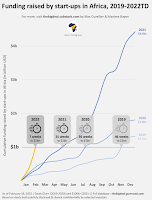
While I agree with the authors of Morgan Stanley's newsletter that many investors are missing out on lucrative opportunities in Africa, there is evidence this is changing. As reflected in the chart at the top of this post, African startups raised $4.4 billion in 2021, which was more than 2.5 times the amount raised in the previous year, according to "Africa: The Big Deal," a website managed by Max Cuvellier and Maxime Bayen.

With respect to specific sectors, fintech startups raised $2.3 billion from investors last year (see chart below). While this sector captured 53% of funds raised, other key sectors such as energy, retail, healthcare, education, and logistics and transportation are also on the rise.


I do not completely believe the notion that institutional investors in America or Europe are investing in African startups because they see the market as a great investment opportunity. Their investment is a result of chasing higher yields since the average junk-bond yields in America and Europe are 5.1% and 3.3%, respectively, well below inflation. And while there is good reason to cheer the recent increases in investments on the continent and the revenues some of these startups are reporting, I am still waiting for announcements of profitability and successful exits through an initial public offering or acquisition. Nevertheless, as someone who has supported tech startups in Africa for over 20 years, I am optimistic that the trend in the number of investors, amount raised, and overall number of startups on the continent will continue to grow for years to come.

I look forward to future conversations with government leaders in Africa on how to reduce their reliance on commodities by investing in education and infrastructure. Such investments will only help their growing working-age population enjoy the fruits of a middle-class lifestyle.

What opportunities and risks are you seeing in Africa's startup ecosystem?

Aaron Rose is a board member, corporate advisor, and co-founder of great companies. He also serves as the editor of GT Perspectives, an online forum focused on turning perspective into opportunity.

July 31, 2021

Lessons Learned in Scaling Digital Solutions in the Water Sector

"Digitalization is transforming how utilities function and how water services are delivered," the GSM Association (GSMA) asserts in a report focusing on scaling digital solutions in the water sector. The report adds: "New technologies not only enable existing systems to operate more efficiently, but also make new service delivery models possible. Some innovations are already available in the water sector, with some solutions scaling, while newer ones are developing."

GSMA's Mobile for Development (M4D) Utilities program works to unlock business models that leverage mobile technology to deliver better and more affordable energy, water and sanitation services in emerging markets. The UK-based organization, which represents the interests of mobile operators worldwide, points out that "Through our Innovation Fund we have provided catalytic support to start-ups, non-governmental organizations, and utilities across Asia and Africa to trial and scale new models." What is more, "This support has helped validate and launch a variety of digital solutions to expand and improve water services." The report examines the experiences of two past Innovation Fund grantees, Wonderkid and CityTaps whose journeys to scale hold lessons for all seeking to accelerate digitalization.

"Both companies are business-to-business (B2B) service providers," the report explains. "Wonderkid provides bespoke software solutions to 40 water utilities in Kenya and other African markets. CityTaps provides pay-as-you-go (PAYG) digital metering solutions to utilities. Currently operating in West Africa and Central America, CityTaps is looking to expand in the Kenyan market. Based on the experiences of these two grantees, we identify some critical considerations for innovators at different stages, from ideation to validation, iteration, refinement, scaling and widespread adoption. Their experiences also highlight some of the strategies and critical stages at which different actors can support innovators to scale, such as funders and the public sector."

The GSMA presents the following supporting actions for key stakeholder groups segmented into five categories:

Funders and Donors
  • Invest in developing digital ecosystems as well as specific solutions and businesses;
  • Support the development of digital skills within utilities and among their users; and
  • Structure support to innovators such that capital is available both at the ideation and scaling stages.
Innovators
  • Be conscious of the capital costs faced by utilities, and structure product offerings to account for these; Maintain a lean approach to the iteration process and develop an adaptable business model; and
  • Focus on building trust and awareness to drive service adoption.
Utilities
  • Mark out a pathway and take steps towards progressive adoption;
  • Make investments in digital readiness;
  • Demonstrate leadership in digital adoption; and
  • Invest in customer education and promotional campaigns to drive adoption.
Mobile Network Operators (MNOs)
  • Pursue partnerships to enhance customer base, product offering and brand image;
  • Create partnerships with utility service providers to encourage service uptake in new markets; and
  • Focus on creating a more accessible environment for third parties.
Government and Regulators
  • Put in place strong performance management systems. This is what creates some incentives for performance improvements; and
  • Ensure that policy allows for utility service providers to form partnerships with innovators and improve their service offering.

Having watched the rapid digitalization in low- and middle-income countries (LMICs) over the past few years, I concur with the report's conclusion:
No single actor can scale digitalization without working with others. Governments, utilities, innovators, MNOs and donors all have unique capabilities and capacity, and it is only by working together that the full benefits of digitalization can be realized. While new innovations are always emerging, there are already many viable technologies in the water sector that have yet to see widespread adoption. These technologies provide the opportunity to tackle long-standing and intractable challenges in the water sector, and benefit hundreds of millions of people who still lack access to a safe, affordable and reliable water source.
Do you agree with the recommended supporting actions for key stakeholder groups? What are your recommendations for transforming how utilities function through digitalization?

If interested in learning more about PAYG as a business model in delivering utilities to people in LMICs, I recommend reading "GSMA Report Explores the Value of Pay-as-You-Go Solar for Mobile Operators in Africa" previously published on this blog.

Aaron Rose is a board member, corporate advisor, and co-founder of great companies. He also serves as the editor of GT Perspectives, an online forum focused on turning perspective into opportunity.

August 22, 2020

Microsoft's Recommendations for Nigeria's Digital Transformation

According to a paper published by Microsoft, "The ubiquity of technology and the Fourth Industrial Revolution (4IR) is revolutionizing business and society in everyday life. The transformational changes of technology addition and the Fourth Industrial Revolution impacts social, economic, political and security dimensions."

Not only are we seeing the early benefits from the Fourth Industrial Revolution in developed markets, it may provide a great impact on those living in developing countries worldwide. It was with great interest that I read Enabling a Digital Nigeria: A Position Paper of Microsoft's Vision for Digital Transformation and a Digital Economy that Works for Everyone, which presents "digital transformation as a means for social and economic development in Nigeria to enable every Nigerian citizen and business achieve more."

Through this paper, Microsoft recommends "twenty (20) policy interventions across four (4) policy areas for the Government to promote a digital Nigeria in such a way as to optimally harness the opportunities of the fourth industrial revolution. The recommendations highlight the gaps that need to be closed to ensure we can capitalize on the benefits of the digital economy. Transforming Nigeria using technologies will require developing a digital ecosystem, infrastructural enhancements in the policy and regulatory environment, education sector and national security. Finally, without deliberate efforts to improve people's national digital awareness and inclusion, both in the private and public sectors, the benefits will be limited."

Below are some of Microsoft's recommendations aimed to drive cloud adoption in the country, which would catalyze the digital transformation of public institutions:
  1. To sustain the traction of a cloud-first policy and other digital transformation initiatives, Government efforts to increase digital and cloud capabilities of the public service are important. The Government should amplify communications of its commitment and support of ICT policies within an enabling environment.
  2. Build digital and AI capacity through the creation of AI knowledge centers across the country as well as the enhancement of scientific research on AI adoption.
  3. Government must optimize its data ecosystem through the development of multi-domain open data repositories that will enhance citizen interaction and amplify the country’s emergency response infrastructure.
  4. Government should ensure technology adoption barriers like costs are fair to all socio-economic groups and offer support and provision of digital applications in sectors such as education and healthcare.
  5. To implement the NITDA’s e-Government Interoperability Framework across the public sector. This provides uniform standards to follow in ICT adoption that will optimize government’s role in driving sustainable development.
  6. Adapt the national education curriculum and delivery methods to align with 4IR and develop digital and non-digital skills such as critical thinking.
  7. The passage of data protection laws unique to the Nigerian context that aligns with cutting-edge technologies, is technology neutral, and balances innovation with protection.
Having witnessed West Africa's technological transformation over the past decade, I concur with the report's conclusion: "The fundamental difference between digitally competitive nations has less to do with technology, but more to do with the transformative strategies that complement digital-savvy leadership, digitally skilled citizens and a collaborative digital culture. By immersing these elements within a conducive policy enabling environment, the Nigerian government can create a sustainable technology ecosystem that will drive digital transformation."

The Fourth Industrial Revolution is presenting a great opportunity for the next generation of Nigerians seeking to participate in the knowledge economy. Microsoft's recommendations provide a strong, stable path for the country's digital transformation. As the report encouragingly says: "We hope this contribution will provide a roadmap for Nigeria to achieve social and economic development goals and derive her share of the $11.5 trillion global digital economy."

Do you agree with the report's recommendations?

Aaron Rose is a board member, corporate advisor, and co-founder of great companies. He also serves as the editor of GT Perspectives, an online forum focused on turning perspective into opportunity.

June 13, 2020

Report Examines Key Trends in Nigeria's Fintech Sector

"Nigeria, Africa's largest country by GDP and population, is among the continent's fintech leaders with a lively crop of start-ups and a growing suite of digital offerings from mainstream banks," says a report produced by The Economist Intelligence Unit (The EIU). "Fintech revenues are forecast to reach an estimated US$543m by 2022, driven by increasing smartphone penetration and its unbanked population."

Sponsored by Mastercard, an American multinational financial services corporation, and MTN Group, an African mobile network operator, State of play: Fintech in Nigeria examines key trends in the fintech sector in Nigeria and assesses both industry drivers and impediments to further growth.

The EIU report addresses the following questions:
  • What solutions are Nigerian fintech providers focusing on?
  • How healthy is the broader ecosystem in terms of venture capital investment, skills and the regulatory environment?
  • What are the key challenges and bottlenecks facing the country as its fintech sector matures?

Moreover, "This report, based on desk research, data analysis and expert interviews, traces the evolution of fintech in Nigeria."

Below are the key findings of the report:
  • Nigerian fintechs are branching out from payments into lending, micro-investment, wealth management, peer-to-peer transfers and insurance. Payments and remittances are the most developed sub-sector to date. The country has seen a surge of new and simplified apps to help merchants, businesses and consumers. Mainstream banks, initially slow to react to the digital era, have quickly adapted to offer apps and tools in areas like loans, while non-traditional players—including telecom companies and retailers such as supermarkets—are entering the finance space.
  • Nigeria's regulatory environment balances innovation and consumer protection but must continually evolve to respond to market dynamics. The Central Bank of Nigeria has passed laws and regulations to promote digital payments and allow more actors to enter the space, boosting competitiveness and consumer choice. But it is balancing these with consumer protections through its cybersecurity framework and data protection regulation. Recent reforms, such as easing entry of start-ups into the capital markets and the creation of a fintech sandbox, could also lead to an enrichment of the ecosystem. While there is no fintech-specific law as yet, a sector roadmap provides overarching direction to the industry. A legal framework may prove necessary to manage the emergence of new types of fintech and accelerate fintech solutions for "insurtech" and wealth management.
  • To develop and flourish, Nigerian fintech needs to address shortcomings in the broader ecosystem. While venture capital investment is forthcoming, the majority comes from abroad with Nigerian investors currently playing a small role. As the sector matures, skills gaps are emerging outside of product development in areas such as business management and marketing. Given the challenges that fintechs in all markets are facing in terms of profitability, expertise in business management and corporate governance is needed. Some experts question whether fintech has truly moved the needle on financial inclusion, believing that it is easing financial transactions for those already in the system. But the jury is still out. Although a causal link with the rise of fintech is unclear, surveys conducted by Enhancing Financial Innovation and Access, a financial sector development organisation, reveal that the percentage of financially-excluded adults in Nigeria reduced from 41.6% in 2016 to 36.8% in 2018.

Having followed the fintech industry in over the past several years, I appreciate the report's assertion that "Globally, the fintech sector is among the most appealing for investors looking for the next wave of disruptive innovation. Digital 'neo-banks' are expanding their market share, especially among younger consumers, while bespoke apps and platforms are taking once-elite financial services, such as stock market investing, into the mainstream."

Referencing a report produced by KPMG, a global audit, tax and advisory services firm, "Total investment activity globally—combining venture capital, private equity and merger and acquisitions—reached a peak of US$120bn in 2018, up from US$51bn in 2017."

What is more, "Africa can lay claim to having laid the foundations of fintech with the mobile money revolution springing out of Kenya back in 2007. Today, it remains a front-runner in financial innovation: The number of fintech companies in Africa grew at an annual rate of 24% between 2009 and 2019, fueled mostly by Nigeria, Kenya and South Africa."

The EIU encouragingly notes that "Nigeria's massive population, entrepreneurial workforce and crop of successful fintech startups could well place it at the leading edge of Africa's financial innovation story. The venture community has validated the local talent pool and fintechs are proving that they are fit for market through year-on-year usage increases. Mainstream banks are also quickening their pace to fend off the threat of disruption by innovating their own products or partnering with start-ups and financial SMEs."

Are you planning to invest or otherwise support Nigeria's fintech sector? If so, what risks and opportunities have you identified?

Aaron Rose is a board member, corporate advisor, and co-founder of great companies. He also serves as the editor of Solutions for a Sustainable World.

May 17, 2019

The Mobile Industry Plays an Increasingly Important Role in Accelerating Social Progress in West Africa

West Africa's mobile ecosystem generated more than $50 billion in economic value last year – equivalent to 8.7 percent of the region's GDP, according to a GSMA study. Authored by GSMA Intelligence, the research arm of the GSMA, The Mobile Economy, West Africa 2019 further finds that rising mobile phone ownership and the ongoing migration to mobile broadband networks and services across the region will see the mobile ecosystem's economic contribution continue to increase over the coming years, forecast to reach almost $70 billion (9.5 percent of GDP) by 2023.

Available in both English and Français, the report reveals that:
  • The number of unique mobile subscribers across West Africa reached 185 million at the end of 2018, equivalent to 48 percent of the region's population. This number is forecast to rise to 248 million by 2025, 54 percent of the population;
  • Future subscriber growth will largely be driven by young consumers owning a mobile phone for the first time; more than 40 percent of the region's population are under 18 years old, according to the report;
  • 3G will overtake 2G to become the leading mobile technology in West Africa this year, supporting about half of the region's mobile connections. 4G momentum is also building: ten new 4G networks have recently launched in West Africa, including the first ever 4G networks in Burkina Faso, Sierra Leone and Togo;
  • Local mobile operators are increasing investment in their networks and are expected to spend $8.5 billion (capex) on network infrastructure and services over the next two years (2019/2020);
  • West Africa's mobile ecosystem directly employs around 200,000 people, supports 800,000 jobs in the informal employment sector, and a further 600,000 jobs across the wider economy; and
  • Mobile is the primary platform for accessing the internet in West Africa; at the end of 2018, there were around 100 million mobile internet users in the region, up almost 20 million year-on-year.
On the topic of mobile contribution to social progress, the report says "[t]he mobile industry plays an increasingly important role in accelerating social progress in West Africa. With a sizeable proportion of the sub-region's population excluded from many services, mobile-enabled digital platforms provide a vital opportunity to deliver solutions that can improve the livelihood of the most vulnerable people in the society and foster greater socioeconomic inclusion. Across West Africa, the activities of mobile operators and other ecosystem players are enhancing digital and financial inclusion, driving innovation and supporting efforts to achieve the United Nations Sustainable Development Goals (SDGs)."

Eleven years remain until the 2030 deadline to achieve the SGDs. The report notes: "Countries in the sub-region face an uphill task to attain these goals, mainly due to acute resource and infrastructure gaps. The mobile industry is, however, well positioned to support governments, the development community and other stakeholders in efforts to accelerate progress on key SDG targets. This is achieved in three main ways:
  • Deployment of infrastructure and networks: The mobile industry drives impact through the provision of – and investment in – high-performing mobile networks, which provide the foundations for the digital economy and act as a catalyst for a diverse and innovative range of services.
  • Access and connectivity: Mobile operators are continuing to connect the unconnected, with 30 million new mobile subscribers and 50 million new mobile internet subscribers across West Africa since 2015.
  • Enabling services and relevant content: Mobile connectivity continues to transform the lives of millions of people across West Africa, by enabling the delivery of life-enhancing services, including education, health and financial inclusion. This is especially significant given the challenge of providing the services by conventional means amid considerable infrastructure and funding gaps."
The report encouragingly explains that "[t]he tech start-up ecosystem in West Africa is growing rapidly, with the emergence of a new generation of tech entrepreneurs and increasing funding from private investors. Tech innovators increasingly use mobile platforms, such as connectivity, mobile money and cellular IoT, to create and distribute innovative solutions that address a wide range of local challenges. This is helping bridge the digital content gap through the development of homegrown content and services with direct relevance to local consumers."

Infographic: GSMA Intelligence
What localized content or services do you think will provide value to West Africa's mobile ecosystem?

Aaron Rose is a board member, corporate advisor, and co-founder of great companies. He also serves as the editor of Solutions for a Sustainable World.

May 8, 2018

Mobile Ecosystem to Be Worth $51 Billion to West Africa Economy by 2022

The role of the mobile technology sector in driving economic growth is a topic that is discussed regularly in this blog. Whether it is in India, Latin America, Southeast Asia, or Sub-Saharan Africa, the mobile ecosystem can play a vital role in empowering billions of people while achieving the 17 Sustainable Development Goals (SDGs), which seek to end poverty, protect the planet and ensure prosperity for all. This post focuses on a report, The Mobile Economy: West Africa 2018, produced by the GSMA Intelligence, the research arm of London, England-based GSMA,

Available in both English and Français, the report presents three major points:

Mobile adoption on the rise

"By the end of 2017, there were 176 million unique subscribers across the West Africa sub-region, comprising the 15 member states of the Economic Community of West African States (ECOWAS),"  Overall subscriber penetration reached 47% in 2017, up from 28% at the start of this decade. Despite the remarkable subscriber growth in the sub-region in recent years, and indeed across Sub-Saharan Africa, more than half of the region's population do not yet subscribe to a mobile service."

Moreover, "Subscriber growth will be driven by a demographic shift in the coming years, as many young adults take out a mobile subscription. Over the period to 2025, around 72 million new mobile subscribers will be added in West Africa, taking subscriber penetration to 54%.

The study importantly explains that "the transition to mobile broadband is gaining momentum across West Africa. 3G remains the dominant mobile broadband technology, but 4G adoption is rising rapidly from network expansion and greater availability of 4G devices. The number of smartphone connections has more than doubled over the last two years to reach 112 million, accounting for 35% of total connections on average at the end of 2017."

Mobile contributing to GDP and employment

The GSMA study says the mobile ecosystem contributed $37 billion to the West African economy in 2017, equivalent to 6.5% of GDP. "The mobile ecosystem consists of mobile operators, infrastructure service providers, retailers and distributors of mobile products and services, mobile handset manufacturers, and mobile content, application and service providers. The use of mobile technology also drives improvements in productivity and efficiency for workers and firms. 3G and 4G technology allow workers and firms to use mobile data and internet services. This improves access to information and services, which in turn drives efficiency in business processes across many industries, including finance and health. This impact of mobile internet is particularly significant where fixed infrastructure is poor and mostly confined to large cities and business & industrial districts."

What is more, "Mobile operators and the wider mobile ecosystem provided direct employment to more than 200,000 people in West Africa in 2017, predominantly in the retailing and distribution of services and handsets. In addition to this, economic activity in the ecosystem creates jobs in other linked sectors as a result of the demand generated by the mobile sector. Going forward, we expect the economic contribution of the mobile ecosystem to continue to increase in both relative and absolute terms. In value-added terms, we estimate that mobile will contribute $51 billion to the West African economy by 2022, equivalent to 7.7% of GDP."

Mobile delivering greater inclusion and empowering consumers

Encouragingly, "The number of mobile internet subscribers doubled over the last four years to reach 78 million, nearly half of the total number of mobile subscribers, by the end of 2017." The number of registered mobile money accounts in the sub-region reached 104.5 million in 2017, while the total value of transactions for the same period reached $5.3 billion. The rapid adoption of mobile services and the funding and infrastructure gaps in the provision of essential services present an opportunity for local innovators to create digital solutions that address a wide range of social and economic challenges across different countries in the sub-region. As of February 2018, there were 142 active tech hubs across West Africa."

Based on my experience of working in West Africa, I agree with the report's assertion:
Collaboration among all stakeholders is required to sustain growth and innovation in the mobile industry across the sub-region. In addition to the work of operators to expand and improve networks, significant efforts from governments at all levels are needed to create the right conditions for continued investment. At the supranational level, ECOWAS is well placed to convene and facilitate dialogue between multilateral stakeholders; serve as a hub for knowledge sharing and dissemination with regards to best practices; and provide a platform to harmonize differences in approach towards key issues that impact the mobile industry across the sub-region. At the country level, national and municipal governments have a role to play in addressing fiscal and regulatory issues that directly impact investment sentiments, especially on capital-intensive infrastructure deployment and the rollout of innovative mobile-based services.
Infographic: GSMA Intelligence
Are you engaged in West Africa's mobile economy? If so, what advice to you have in creating solutions that will end poverty, protect the planet and ensure prosperity for all?

Aaron Rose is a board member, corporate advisor, and co-founder of great companies. He also serves as the editor of Solutions for a Sustainable World.

May 30, 2017

Digital Technology in Côte d'Ivoire Is Transforming the Way People Live, Work, Play and Communicate

Following from my previous post about a GSMA report focusing on the growing mobile technology sector in West Africa and the socioeconomic benefits this will bring to the region, the London, England-based organization also published a report asserting how "the mobile industry has contributed to enormous change" in the West Africa nation of Côte d'Ivoire. Available in both English and Français, the report explains: "Digital technology in Côte d'Ivoire is evolving rapidly, leading to the emergence of new services and applications that are transforming the way people live, work, play and communicate."

The report claims "mobile technology is also revolutionizing the delivery of healthcare and agricultural services. Platforms have been developed that enable doctors and health professionals to communicate directly with patients through voice calls and SMS, significantly benefiting rural communities that would otherwise have to travel long distances to receive such services." Moreover, "Mobile platforms have also been used to provide farmers and agricultural firms with up-to-date information on market prices, production techniques and weather. Such mAgri services currently have almost half a million users in Côte d'Ivoire."

The report also illustrates the beneficial role mobile technology will play in achieving the "17 Sustainable Development Goals (SDGs) seeking to end poverty, protect the planet and ensure prosperity for all. This high-level ambition is made specific by the 169 targets that sit behind the SDGs and provide greater direction, quantification and timing for each goal. The intention is to meet all the targets by 2030, with some requiring earlier attainment."

Encouragingly, "The mobile industry was the first to come together and make a commitment to sustainable development and the goals. As part of this commitment the GSMA has started to assess how mobile technology contributes to the SDGs. The first report was launched at the UN Private Sector Forum in September 2016 and provided a framework to assess the industry's impact on the SDGs.

"All SDGs are affected by the mobile industry to varying degrees. Basic voice connectivity offers many societal, economic and environmental benefits, and upgrading to mobile broadband, to smartphones, and further to M2M (machine-to-machine) and IoT (Internet of Things), together with rapid digital transformation, creates a significant opportunity for the industry to support governments in meeting their SDG commitments."

The report dives deeper on mobile connectivity and its impact on SDGs by explaining: "The mobile industry's core mission is to provide connectivity. The provision of voice, SMS and data connectivity impacts all 17 SDGs. For example, mobile connectivity reduces the costs of accessing information and can create or expand markets by enabling the mechanisms for buyers and sellers to discover each other and conduct transactions, driving more inclusive growth. This is particularly relevant to SDGs 1 – No poverty, 5 – Gender equality, 8 – Decent work and economic growth, 9 – Industry, innovation and infrastructure, and 10 – Reduced inequalities.

"Another example is the use of mobile for emergency calls and broadcasting, which can play a critical role in the response to and management of natural and man-made disasters, which is relevant to SDGs 1 – No poverty, 2 – Zero hunger, 3 – Good health and well-being, 11 – Sustainable cities and communities, and 13 – Climate action. Additionally, mobile services enable users to access essential information such as health advice and educational tools, key to SDGs 3 – Good health and well-being and 4 – Quality education."

The report's final chapter focuses on opportunities for public-private collaboration. It notes that "mobile financial services have had a significant social and economic impact in many countries and are a key driver for many SDGs. Today, Côte d'Ivoire has the highest penetration of mobile money accounts in West Africa, and mobile money is already being used by the government to facilitate the payment of over 1.7 million secondary school fees each year. Further rollout of mobile financial services will continue to contribute to Côte d'Ivoire's achievement of the SDGs.

Image: GSMA
"Additional areas of opportunity include other mobile-enabled services such as energy, health and education. Given that just over 50% of the population have access to electricity, providing innovative ways for people to access electricity is important, particularly in rural areas, such as with pay-as-you-go solar home solutions. For this to be realized it is important to have the right infrastructure in place as IoT is still nascent in the country. Additionally, given low levels of literacy in the country and low health outcomes (such as high levels of maternal and infant mortality, and high levels of food insecurity), the Ministry of National and Technical Education (MENET), the Ministry of Health and mobile operators could collaborate to meet the goals on good health and well-being (SDG 3) and quality education (SDG 4)."

I agree with the claim presented in the report's Executive Summary: "Closer collaboration between the Ivorian mobile industry and the various line ministries of its government offers a strong opportunity to support Côte d'Ivoire's social and economic progress." Do you have specific ideas on how mobile technology can contribute to the achievement of the SDGs?

Aaron Rose is an advisor to talented entrepreneurs and co-founder of great companies. He also serves as the editor of Solutions for a Sustainable World.

May 29, 2017

Mobile Technology Is Helping to Achieve Sustainable Development Goals in West Africa

A new report published by GSMA explains that "by the end of 2016, there were 172 million unique subscribers in West Africa, accounting for 320 million mobile connections. The sub-region's subscriber penetration rate now stands at 49%, slightly higher than the 47% penetration rate across the wider Sub-Saharan Africa region." The Mobile Economy West Africa 2017, which is available in both English and Français, further asserts: "Over the next four years, West Africa will see average subscriber growth of 6%, one of the fastest rates globally, resulting in an additional 45 million subscribers by 2020. The biggest market in the sub-region – Nigeria – will account for two-thirds of this growth, with another quarter coming from Benin, Côte d'Ivoire, Mali, Niger and Senegal."

In the chapter titled, "Mobile Enabling Innovation," the report says: "Mobile has emerged as the platform of choice for creating, distributing and consuming innovative digital solutions and services across West Africa. This trend is driven by the rapid expansion of mobile networks across the sub-region and the growing adoption of smartphones. More than a quarter of the population now subscribe to mobile internet services, a figure that will nearly double to 43% by 2020."

Furthermore, mobile technology is "helping achieve the UN Sustainable Development Goals (SDGs) in the subregion, providing access to tools and applications that address a range of socioeconomic challenges. Mobile has been used, for example, to spread awareness of disease outbreak, such as the Ebola virus in 2014/15, and by the World Food Program to provide humanitarian assistance to refugees and displaced persons in Mali and Nigeria."

In the chapter titled "Realizing the Full Potential of Mobile Across West Africa," the report notes that "the mobile industry makes an important contribution to the economy across the West Africa region, driving economic growth and jobs while helping to fund public services."

I am encouraged by the findings of the GSMA report with respect to the role mobile technology will play in West Africa's socioeconomic development. In the coming years, my colleagues and I will see local startups in the region developing innovative platforms and services in cloud computing, connected devices, e-commerce, financial technology and mobile applications (particularly in education and health).

What are you thoughts about the report?

Aaron Rose is an advisor to talented entrepreneurs and co-founder of great companies. He also serves as the editor of Solutions for a Sustainable World.