Showing posts with label Investing. Show all posts

April 2, 2024

'Buy Low, Sell High'

A conversation I often have with a beginner investor about the formula of becoming successful investor in public equities often goes like this:

Beginner Investor: "How do I become a successful investor?"

Me: "Buy low, sell high."

Beginner Investor: "That's all?"

Me: "Yes, that's all."

While it is technically that simple, the reality is much different as there are various nuances to go into which stocks to buy, when to buy them, and when to execute a sell order. Jim Cramer, a financial journalist on CNBC, presents his approach on how to start picking individual stocks. "Stock picking is not simple and requires substantial research, he said, stressing that it's essential not to shoot blindly. Instead, it's wise to invest intentionally and put money into stocks and sectors you’re familiar with.

"'You want to get started? Go small, invest in what you know, research intensely,' Cramer said. 'Back then, I got old data from the public library. Now? It’s as simple as a key stroke, and the information's free — including up to the minute financials, analyst presentations, brokerage research and, of course, the conference calls that I tell you are musts if you want to actually know what you’re doing.'"

Jim Cramer's Guide to Investing contains 25 points to becoming a successful investor. There are a few worth discussing:

6. "Buy and Homework, Not Buy and Hold"

Mr. Cramer explains that within a diversified portfolio, "the facts change, the leaders become followers, the disrupters disrupt, consumer preferences change and so on. The facts change and so must our investment thesis. If you're not doing the homework then how are you going to be sure that what you bought in the past is still what you own today?"

He points out that "The two reasons people often don't do the homework is because they have either (wrongly) convinced themselves that if they hold long enough that ultimately all stocks make a comeback, or that since they don't have the time to do it, nobody does."

I strongly support his assertation that "On the first reason, that's just nonsense. Stocks represent ownership in a business. The notion that a business that is doing poorly will always improve and return
to strength is just silly. If that was the case, there would be no bankruptcies or disrupters displacing leaders. Industry landscapes are always changing, businesses are living, breathing entities and without
proper stewardship will fail. Ultimately, the stock will follow the fundamentals."

With respect to the second point, he says that "you may not have the time, but that's what professionals are paid to do. Make the time. If you can't keep up with the homework— be it because of time restrictions or a lack of understanding when it comes to financial statements—then you either need to own fewer stocks or hand it off to a professional. Tracking companies may not be your day job, but it is a pro's job."

7. No One Ever Made a Dime by Panicking

"Emotion, especially panic, has no place in investing," according to Mr. Cramer. "When we panic, we don't think clearly. And when we aren't thinking clearly, we make mistakes. If you associate the value of what you own with the price a stranger is willing to throw at it, it can be easy to panic when the bids come in low." I support his analogy that "just because someone offers you less for your house today than the price you paid yesterday doesn't mean it is any less valuable. It may simply mean that the current bidders don't see the value you see."

He adds: "When volatility strikes, you should focus more on the value of what you own than the price being put on it. By doing that and keeping level head, you can make rational decisions and perhaps realize that there will be a better time to sell— either when things calm down or your investment thesis materializes and other buyers begin to see the value that you've seen all along."

11. Don't Own too Many Stocks

Following on the importance of doing your homework, Mr. Cramer recommends "One hour of research on each stock per week. That's the rule of thumb on keeping up with the homework. If you can't manage that then you own too many stocks."

12. Cash and Sitting on the Sidelines are Fine Alternatives

Particularly when interest rates for savers were low for so long, many beginning investors thought it was erroneous to have cash in the bank. They pressured themselves into think they should put most, if not all, of their cash in the stock market. As Mr. Cramer notes, "The aversion to cash that most investors have is truly to their detriment. So many are fearful of the 'cash drag' on the way up— meaning that they fear underperforming due to part of their portfolio not being invested, that they fail to think of the positive addition that same cash drag can add to performance in a down market. Believe it or not, you can keep some of your portfolio in cash. If you don't have a feel for the market, step to the sidelines. That's the beauty of a no-called-strike game, you can sit there for as long as you like waiting for that perfect pitch."

What is more, "Some investors believe they should be fully invested, or they'll lose out to inflation. That's not a reason to invest. You only want to take a position, long or short, when you have an edge. If you have nothing compelling to buy, meaning you're only going to find it more attractive if it goes down in price, then step to the side. It's better to lose a few percentage points of buying power to inflation than it is to lose money on a low conviction, no-edge position. The idea that you should
invest so that you have 'enough exposure' is just nonsense. There is one reason and one reason only to invest— to make money."

24. "Be Able to Explain Your Stock Picks to Someone Else"

"I like to say that if you can't explain why you want to own the stock in three bullet points, you shouldn’t buy it," Mr. Cramer writes. "Not only will doing so help you better understand the story, but in doing so you will better discover if there is something you missed. Ideally you will even find someone with the opposite view of your own and have a good old fashion bull-bear debate."

His investment guide includes a list of eight questions his ex-wife would ask "over and over again whenever he wanted to put on a new position":
  1. What's going to make this stock go up?
  2. Why is it going to go up when you think it is?
  3. Is this really the best time to buy it?
  4. Haven't we already missed a lot of the move?
  5. Shouldn't we wait until it comes down a little more?
  6. What do you know about this stock that others don't?
  7. What's your edge?
  8. Do you like this stock any more than any of the others you own and why?
"That last one was especially important because she never liked to add another stock without taking one off. After all, how many good ideas can a person have at once? Moreover, sticking to that rule will help you abide by rule 11 and keep up with your homework."

Aaron's Rule: Do Your Homework

Most publicly-traded U.S. corporations are required to file a Form 10-K with the U.S. Securities and Exchange Commission (SEC). The document gives a comprehensive summary of a company's financial performance during the company's most recent fiscal year. I read the 10-K of each corporation that is in my investment portfolio. And I often read the 10-Ks of corporations that are competitors or partners of the corporation I hold stock in.

While the SEC provides a useful guide on how to read a 10-K, there are certain parts of the 10-K that I pay close attention to. Item 1 - "Business" is where the corporation provides a detailed description of its business including its main products and services, what subsidiaries it owns, and what markets it operates in. This section may also include information about recent events, competition the company faces, regulations that apply to it, labor issues, special operating costs, or seasonal factors. This is a good place to start to understand how the company operates.

I strongly recommend learning about the risks that may have a material effect on the company's operations or financial performance. Item 1A - "Risk Factors" includes information about the most significant risks that apply to the company or to its securities. Companies generally list the risk factors in order of their importance. In practice, this section focuses on the risks themselves, not how the company addresses those risks. Some risks may be true for the entire economy, some may apply only to the company's industry sector or geographic region, and some may be unique to the company.

Understanding the management's perspective on the business results of the past financial year is crucial to helping me evaluate the worthiness of owning the company's stock. Item 7 - "Management's Discussion and Analysis of Financial Condition and Results of Operations" gives the company's perspective on the business results of the past financial year. This section, known as the MD&A for short, allows company management to tell its story in its own words. The MD&A presents:
The company's operations and financial results, including information about the company's liquidity and capital resources and any known trends or uncertainties that could materially affect the company’s results. This section may also discuss management’s views of key business risks and what it is doing to address them.
Material changes in the company's results compared to the prior period, as well as off-balance sheet arrangements and the company’s contractual obligations.
Critical accounting judgments, such as estimates and assumptions. These accounting judgments – and any changes from previous years – can have a significant impact on the numbers in the financial statements, such as assets, costs, and net income. 
Source: U.S. Securities and Exchange Commission
I also read the quarterly earnings report, known as Form 10-Q, and listen to the earnings report which generally include statements by the corporation's chief executive and chief financial officers. Shareholders often have the opportunity to pose questions to the corporate executives. The SEC reports and information about the quarterly earnings calls are often found on the company's website under "Investor Relations."

Building a valuable investment portfolio is not difficult, but it does require time to learn about the company's business, financial performance, and risks that may adversely impact both. What resources do you use to evaluate the investment worthiness of a corporation?

Aaron Rose is a board member, corporate advisor, and co-founder of great companies. He also serves as the editor of GT Perspectives, an online forum focused on turning perspective into opportunity.

March 3, 2022

How to Reduce Africa's Reliance on Commodities

"Despite being home to 17% of the world's population, Africa is an underinvested market," a newsletter published by Morgan Stanley, a financial services firm, says. The newsletter also points out that "72% of investors surveyed do not currently invest there. We believe that despite near-term challenges, the continent offers compelling long-term opportunities vis-à-vis private markets and infrastructure."

Moreover, "Africa's median age, at 19.7, is considerably lower than those of Asia and South America, at 32.0 and 32.1, respectively. Furthermore, according to the World Economic Forum, Africa is expected to have the world's largest working-age population by 2034. The expected increase in the working-age population will likely promote middle class growth, building on trends already in place."

As an investor and entrepreneur, I appreciate how these statistics represent future opportunities. However, as an advisor to several officials representing African nations, I wish these leaders understood the importance of these statistics and the opportunity that exists for the citizens they represent. In my conversations with African government officials, I am often asked for my opinion on how to attract foreign direct investment to grow their private sector. While I strongly advocate for establishing policies and making investments to build a thriving digital economy in Africa, these officials mistakenly focus our conversation on how to increase their overdependence on raw materials and commodities such as minerals, oil, gas, and lumber.

Even The Economist notes that "many African economies have relied too much on raw materials for too long." The article further explains that "The UN defines a country as dependent on commodities if they are more than three-fifths of its physical exports. Fully 83% of African countries meet that threshold, up from 77% a decade ago. Some depend on produce such as tea, but most rely on mining or on pumping oil. When commodities crashed in 2015, foreign direct investment (FDI) and growth tumbled and have yet to fully recover."

The article importantly adds: "Broad averages obscure some of the progress that has been made to diversify economies. Over the past decade resources have become less important to GDP. The share of commodities in goods exports from the continent as a whole has fallen, too. And in countries such as Botswana and Malawi, services have grown strongly. Even manufacturing is rebounding."

However, "Africa has a long way to go if it is to break free of the resource curse. In countries rich in diamonds or oil, political power can be a license to loot. So unscrupulous folk are tempted to grab and hang on to it by any means available. Resource-rich countries are more likely to suffer dictatorships, and also tend to have more and longer civil wars."

Building a thriving economy while strengthening government institutions with better transparency and will require investments in education and infrastructure. Using Sierra Leone as an example, The Economist says the west Africa nation "now spends about 21% of its budget on education, up from 13% in 2017. As a result, more youngsters are passing their final exams than ever before. Mining began in Sierra Leone about a century ago. 'If we had invested in humans for a hundred years,' sighs David Moinina Sengeh, the education minister, 'we would be in a much better place today.'"

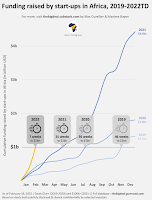
While I agree with the authors of Morgan Stanley's newsletter that many investors are missing out on lucrative opportunities in Africa, there is evidence this is changing. As reflected in the chart at the top of this post, African startups raised $4.4 billion in 2021, which was more than 2.5 times the amount raised in the previous year, according to "Africa: The Big Deal," a website managed by Max Cuvellier and Maxime Bayen.

With respect to specific sectors, fintech startups raised $2.3 billion from investors last year (see chart below). While this sector captured 53% of funds raised, other key sectors such as energy, retail, healthcare, education, and logistics and transportation are also on the rise.


I do not completely believe the notion that institutional investors in America or Europe are investing in African startups because they see the market as a great investment opportunity. Their investment is a result of chasing higher yields since the average junk-bond yields in America and Europe are 5.1% and 3.3%, respectively, well below inflation. And while there is good reason to cheer the recent increases in investments on the continent and the revenues some of these startups are reporting, I am still waiting for announcements of profitability and successful exits through an initial public offering or acquisition. Nevertheless, as someone who has supported tech startups in Africa for over 20 years, I am optimistic that the trend in the number of investors, amount raised, and overall number of startups on the continent will continue to grow for years to come.

I look forward to future conversations with government leaders in Africa on how to reduce their reliance on commodities by investing in education and infrastructure. Such investments will only help their growing working-age population enjoy the fruits of a middle-class lifestyle.

What opportunities and risks are you seeing in Africa's startup ecosystem?

Aaron Rose is a board member, corporate advisor, and co-founder of great companies. He also serves as the editor of GT Perspectives, an online forum focused on turning perspective into opportunity.
November 24, 2021

Is Jihadism a Risk Factor for Investing in Africa?

A startup's board of advisors?
(Image credit:
http://ow.ly/O0qE50GW8Mq)
Investing in Africa has been a regular topic of discussion among my friends and colleagues over the past year. I published a post on this forum about a report that says African tech startups raised $1.4 billion in 2020 with the fintech sector receiving 25 percent or $354 million of the total amount. And I am confident this amount will be significant higher for 2021. While there are many reasons to remain optimistic about the future of Africa's digital economy, particularly in the fintech, agritech enterprise, and health tech sectors, investors should be mindful of the risks that exist which may negatively impact a company's operations and financial performance. One such risk is the growing security instability on the continent.

I often hear people from Africa express their frustration that many people residing outside the continent view their homeland as a place ravaged by war and disease. They say the global media perform a disservice by focusing on the negatives while neglecting to report on advancements made in key areas including economic development, education, and rule of law. I agree with their feelings of frustration as I have witnessed the exponential economic growth since the time I made my first investment in Africa in 1995. However, armed conflicts on the continent exist in many areas. There are concerns that these conflicts will spread to cities that have experienced significant economic growth over the past two decades.

At the time of publishing this post, there are growing insurgencies by jihadists and separatists in the Sahel, the ecoclimatic and biogeographic realm of transition in Africa between the Sahara to the north and the Sudanian savanna to the south (see map on the right). According to an article published by The Economist on Nov. 20th, 2021, "almost 9,000 European and American troops on the front line of what is now the West's biggest offensive against jihadists, in the Sahel. It is not going well. How it will end depends in no small part on whether the West learns the right lessons from its failures in Afghanistan."

During my time working on private sector development initiatives in Afghanistan, my colleagues and I evaluated security risks based on the flow of funds and weapons to jihadists. Entrepreneurs and small business owners living in Afghan provinces that received the largest percentage of imported weapons and funds to support jihadists and violent extremists experienced more risks to their business including corruption, lack of access to essential services such as electricity and water, and restrictions on the hiring of women.

With the United States' withdrawal from Afghanistan this past summer, jihadists around the world "were elated by the fall of Kabul," In another article published on Aug. 28th, 2021, The Economist notes: "Through willpower, patience and cunning, a low-budget band of holy warriors has vanquished America and taken charge of a medium-size country. To Muslims who yearn to expel infidels and overthrow secular states, it was evidence that God approves. The ripple effects could be felt far and wide."

The article adds that "outside Afghanistan, the main ripple effects will be psychological. The Taliban's triumph will fire up jihadists in other countries, and spur recruits to join them. Some who live in rich countries will be inspired to commit acts of terrorism there. It does not take many such attacks to sow a sense of fear or roil domestic politics.

"Even worse will be the effect in poorer, weaker states, where jihadists aspire not merely to kill but to control territory, or at least prevent the government from doing so. In places like Pakistan, Yemen, Syria, Nigeria, Mali, Somalia and Mozambique, they already do. In several other parts of Asia, Africa and the Middle East, they threaten to. Many are asking: if our Afghan brothers can beat a superpower, surely we can beat our own wretched rulers?"

The Economist Intelligence Unit's latest Democracy Index, which provides "a snapshot of the state of democracy worldwide in 165 independent states and two territories," says "[t]he deterioration in the global score in 2020 was driven by a decline in the average regional score everywhere in the world, but by especially large falls in the 'authoritarian regime'-dominated regions of Sub-Saharan Africa and the Middle East and North Africa."

Moreover, The Economist, in its Aug. 28th article, asserts:
Bad government creates an opening for jihadism. When a state is unjust, its citizens may imagine that one run by jihadists might be better. Even if they do not take up arms, they may quietly support those who do. Many rural Afghans decided that Taliban justice, though harsh, was quicker and less corrupt than government courts, and that Taliban checkpoints were less plunderous. This is one reason the Taliban's final march to power met so little resistance. The other was psychological: they won because when America pulled out Afghans did not want to die fighting for a lost cause. Similar principles apply elsewhere. Jihadists in north-eastern Nigeria are hard to beat because locals detest the central government and army officers sell their own men's weapons to the guerrillas and pocket the cash.
In an email message to my colleagues and clients where I shared a link about a webinar the U.S. Department of Commerce is hosting on Nov. 30th, 2021, which will allow participants to hear real-time market conditions and learn about technology and commercial digital transformation opportunities in Ethiopia, Mozambique, Nigeria, and Kenya, I included a message saying that this event should be interesting given the first three of these countries are currently experiencing some form of conflict by jihadists or violent extremists. As for Kenya, the East Africa country is on high alert because of recent suicide bombings in neighboring Uganda.

Barring Ethiopia where the Tigray People's Liberation Front are taking towns on the way to the country's capital, Addis Ababa, most armed conflicts occur in rural areas far from capital cities or economic centers. Given the rise of authoritarian regime-dominated regions in sub-Saharan Africa, coupled with jihadists feeling emboldened by the Taliban's recapturing of Afghanistan, it may be a matter of time until we see armed conflict in cities that are experiencing a vibrant startup ecosystem.

I remain optimistic about business and investment opportunities in Africa, particularly in the continent's digital economy. But those who are launching a new firm or investing in one should perform an assessment of country-level risks including evaluating the safety of the physical environment. In determining the risk of rising jihadism, follow the money.

If you are investing in Africa, which risk factors are you paying attention to?

Aaron Rose is a board member, corporate advisor, and co-founder of great companies. He also serves as the editor of GT Perspectives, an online forum focused on turning perspective into opportunity.

March 8, 2021

347 African Tech Startups Raised $1.4 Billion in 2020, Says Africa Tech Venture Capital Report

347 African tech startups raised a total of US$1.43 billion in 358 equity rounds in 2020, according to the 2020 Africa Tech Venture Capital Report published by Partech Partners, a venture capital firm with offices in San Francisco, Paris, Berlin, and Dakar. This was an increase of 250 rounds by 234 startups in the previous year, which represents a year-over-year (YoY) growth rate of 44% in deal count.

"This is quite remarkable," the report says. "In such a challenging year, more startups have closed rounds than in any previous year. Activity has grown by almost half. No other region in the world has seen anything like this. The global interest for the African tech ecosystem remains strong even in the context of the global crisis driven by the pandemic."

However, not all is rosy. The equity funding raised by African tech startups in 2020 totaled US$1.429 billion compared to US$2.02 billion in 2019, a YoY decline of 29%. As the report explains: "Despite a strong growth in activity, the total amount raised by African startups decreased for the first time after nearly a decade of accelerating growth. While it is still higher than 2018 and before, this sharp drop clearly marks the impact of the pandemic and subsequent lockdowns."

What is more, "Activity has drastically reduced for mega rounds (above US$50M), barely grown on large-size deals and accelerated on venture-type rounds."


More encouragingly, however, "As the table above shows, the activity level has increased for almost any deal below the US$50M size. Deals between US$200k and US$1M have actually almost doubled, keeping up with previous trends. The main drive for the lower total amount of equity funding raised seems to be the disappearance of mega-rounds. Indeed, when we exclude rounds above US$50M, this total equity amount raised is flat between 2019 and 2020. Thus, this explains to a great extent the drop in funding amount."

Focusing on a breakdown by country, the report maintains that "As in previous years, VC Funding is still concentrated in few markets, but we see strong signs of diversification as half of African countries are now in play."
  • Nigeria remains Africa's top destination with US$307M invested (21% of all equity funding) with Kenya following closely behind with US$305M.
  • Egypt completes its rally toward #1 in equity deal count, with 86 deals (+83% YoY), almost a quarter of the continent's VC transactions.
  • African VC investment remains centered around 4 top countries attracting 80% of the volume invested. However, we see more diversification as Ghana reaches a solid #5 spot, with a 102% increase in equity funding to reach US$111M and in total an unprecedented 26 countries have attracted capital.


As indicated in the image above, fintech is still the leading vertical with 25% of funding (despite a 57% YoY drop in volume). The 2020 highlight, however, is on the rising investment in the digitization of key economic sectors with agritech (US$179M), logistics and mobility (US$157M), offgrid/energy (US$148M) and health tech (US$141M).

"When we further breakdown funding in each vertical by markets, it's clear that investors in each vertical focus on a few countries":
  • "Fintech investment is quite concentrated with Nigeria (38%), Egypt (28%) and Ghana (13%) attracting together nearly 80% of all the funding in this vertical.
  • "Agritech is even more concentrated with 79% of the equity funding in this vertical flowing into Kenya. However this is partly driven by a single large deal at US$85M.
  • "Nearly half of Enterprise funding goes to South Africa. And the same applies with half of funding in Logistics, Mobility and Edtech flowing into Egypt."

Focusing on gender, the report reveals that female-founded startups raised 13% of the rounds in 2020, a four point decrease from 17% in the previous year. But they accounted for 14% of the total equity funding just above 13% in 2019.

Moreover, female-founded startups raised US$204 million in equity funding in 2020, a 22% drop from the previous year. Interestingly, startups in Kenya accounted for 65% of this amount keeping with a similar trend in 2019 when 78% of funding to female-founded startups occurred in Kenya.

As for giving a breakdown of the investors, "Africa's tech ecosystem is not only attracting more investors (+24% YoY), but they are also more committed to the market, with 108 of them involved in 2 or more deals and 22 very active in 5+ deals." Furthermore, "443 unique equity investors were involved in the 359 equity rounds raised by African startups in 2020. It was around 87 when we started tracking this metric in 2017, a 5x growth in 3 years."

"Looking at the investors' distribution per stage, early stages' attractiveness is strongly confirmed with 421 active investors involved in Seed+ transactions (228 rounds), 229 investors in Series A (through 86 rounds), 80 investors in Series B (29 rounds) and 43 active investors in the 16 Growth rounds."

Partech Partners provides the following explanation to its methodology noting that the firm reports on tech and digital VC equity deals above US$200k, in African startups:
  1. The numbers are about equity deals. This means Partech excludes everything else: grants, awards, prizes, conventional debt, venture debt, loans, Initial Coin Offering (ICO), non-equity/technical assistance, post-IPO and M&A deals. Examples: Twiga Foods US$29.4M debt from IFC announced in Oct 2020 is not counted. Lumos Global's debt round of US$45M from DFC announced in September 2020 is also not counted.
  2. The numbers only include equity funding rounds higher than US$200k. This includes deals that Partech categorize as Late Seed (Seed+) to Growth stage equity rounds. Angel deals and smaller Seed deals below US$200k (numerous on the continent) are omitted voluntarily. Example: Credit startup Swipe's round of US$120k funding from YC as part of the W20 batch in March 2020 is not counted.
  3. Partech focuses solely on VC deals that are in the tech and digital spaces. This means Partech only count companies where the value is built around digital technology. Example: In May 2020, the Series A of US$11.2M of insect-based feed and fertilizers company, NextProtein, was not counted.
  4. The firm covers African start-ups that they define as companies with their primary market, in terms of operations and/or revenues, in Africa but not based on HQ or incorporation. When this company evolves to go global, Partech will still count it as an African company. Example: Gro Intelligence’s US$85M Series B round is counted as an African deal, as it was founded in Kenya before expanding to the USA.

Having been engaged in the African market as an investor for over two decades, I am encouraged to see the steady rise in the number of tech companies that are raising funds as well as the increasing number of investors who are investing in the continent. As addressed in previous posts on this forum, I remain optimistic on the potential opportunities in high-growth sectors including fintech, agritech, digital health, e-commerce, connected devices (Internet of Things or IoT), and logistics technology and mobility. Challenges remain, however, including the disproportionate number of female-founded startups receiving support from investors. While not mentioned in the report, challenges I have encountered as an investor in Africa include systemic corruption, burdensome government regulations, and an inadequate supply of infrastructure, just to name a few.

What do you think of the report's findings? Which sectors will present the greatest opportunity for investors in Africa?

Aaron Rose is a board member, corporate advisor, and co-founder of great companies. He also serves as the editor of GT Perspectives, an online forum focused on turning perspective into opportunity.

January 3, 2021

What Is Intellectual Property and Why You Should Protect It

The value of many businesses may be found in its intellectual property (IP), which include patents, trademarks, copyrights and trade secrets. Protecting your IP by filing the necessary application with the U.S. Patent and Trademark Office (USPTO) is crucial to protecting your creativity, idea or brand. Understanding the USPTO's complex application system, however, can be overwhelming. Adam Philipp, Founder of AEON Law, an intellectual property law firm focused on patent, trademark, copyright, trade secret, and related IP matters, presented "VIPs: Very Important Patents" to the Seattle Entrepreneurship Club (SEC). His presentation brought clarity to defining intellectual property and how a business should protect its invention or brand.

Organized in 2008, the SEC is a nonprofit organization that offers a variety of services to help entrepreneurs, investors, and professionals succeed in Seattle and throughout North America. The Medina, Wash.-based organization also cooperates with organization in different industries and fields to promote the exchange of enterprises, talents, and culture between China and North America. While I recommend watching Mr. Philipp's presentation in its entirety via this link or in the embedded video at the end of this post, here a few takeaways entrepreneurs and investors may find of value on why and how they should protect their IP.

Mr. Philipp presented six reasons on why you should file for a patent:
  1. Marketing: Good for public relations. "There is a stamp of legitimacy, particularly in the U.S., if a consumer hears that they are using patented technology";
  2. Defense: Prove possessed of the invention. "Let's other companies know that you have been working on this technology at a provable point in time and it puts them on notice that they shouldn't threaten you if you were ahead of them";
  3. Access: Leverage to others' IP. "A more sophisticated way of using intellectual property is patents are a special kind of tool that can be a force multiplier. So a small company with a strong patent can get the attention of a much larger company to get access to that larger company's IP. If the larger company is either threatened or wants access to the patented technology from the smaller company, the patent can be a lever that will move in otherwise much larger adversary or potential partner";
  4. Monetization: License the patent for money. "You can use your patent like you would any other piece of property; it's like your car or house. You can give permission for other people to use it in exchange of something of value, usually money";
  5. Offense: Sue for money or injunction. When your patent is infringed upon, "you can sue for money or damages, or you can sue for injunctions," which is "getting a court to tell somebody to stop doing something"; and
  6. Value: Patents are assets. "Many companies value the use of patents as a barrier-of-entry tool that keeps competitors from getting into the same marketplace and boosts the value of the company that owns the patent. So patents are seen as company assets and can boost the valuations or the perceived value of the company."
Mr. Philipp talked about one additional reason on why you should file for a patent. The calendars of most investors, myself included, are full with meetings with entrepreneurs who are trying to raise capital for their business ventures. These entrepreneurs often request investors sign nondisclosure agreements (NDAs). But most investors will rarely sign one because doing so creates an undue burden on the time and cost of negotiating and monitoring the multitude of NDAs (a point that I address in my post, "There Is No Such Thing as a 'Standard NDA'"). Therefore, according to Mr. Philipp, an investee who has an interesting invention should obtain a patent before soliciting funds from an investor. "Revealing a trade secret without some form of confidentiality agreement (e.g., NDA) destroys the trade secret."

When I started my career in the early 1990s, it was common for the USPTO to take five or more years to examine a patent application. The long period of time often deterred companies from going through the patent application process. Today, through the USPTO's Prioritized Patent Examination Program (also known as Track One), Mr. Philipp encouragingly noted the examination process has been shortened to 4-10 months. "This has been dramatically changing how people think about IP protection, particularly patent protection with startup companies because once you have an enforceable tool that can keep people out of the marketplace, that can be a powerful tool with the right kind of investment."

Trademarks, Mr. Philipp explained, is a word, phrase, logo or other identifier (e.g., brands) of a source of goods or services. In the U.S., trademarks are used in commerce and they protect against other companies using a confusingly similar mark or similar goods or services. As for when a company should register its trademark, the time to consider trademark protection is when the company dedicates $5,000 or more in its marketing or brand enhancement strategy. "Why spend all that money only to find out someone has beat you to it beforehand?" asks Mr. Philipp.

While it is advisable to retain the services of a U.S.-licensed attorney to file the patent or trademark application with the USPTO, I encourage you to become familiar with the government agency's website to learn more about the patent application and maintenance process as well as the basics of trademarks.


What aspects of Mr. Philipp's presentation did you find of value? What has been your experience in protecting your company's IP?

Aaron Rose is a board member, corporate advisor, and co-founder of great companies. He also serves as the editor of GT Perspectives, an online forum focused on turning perspective into opportunity.

September 19, 2020

EIU Report Explores How to Invest in a Post-Covid World

Investors may support the following observation by The Economist Intelligence Unit (The EIU): "Equity markets have shown extreme volatility in 2020 and become increasingly disconnected from economic fundamentals: markets are being driven up by central bank liquidity and fiscal stimulus, while the real economy is in one of the deepest recessions of the last 100 years."

In its report, Where have all the fundamentals gone? Investing post-Covid, The EIU suggests that "the coronavirus (Covid-19) pandemic and geopolitical tensions are disrupting business models and may require radical changes in investment strategies."

The EIU "believes that three key themes are going to be vital for investment performance over the next five years.
  • "No end to monetary stimulus in sight. With major economies unlikely to return to their pre-Covid-19 level of output for years, inflation and rising interest rates are not currently a threat. As a result, asset prices are likely to remain decoupled from economic data for some time, but fundamentals will affect relative performance.
  • "Prepare for a backlash. Investors should be braced for political shocks ranging from tax increases to disorderly sovereign defaults. Governments are likely to expect more in return from companies that they have showered with wage subsidies and loan forgiveness. Countries with adaptable economies and high levels of political cohesion will be the safest bets.
  • "Prepare for a bipolar world. Covid-19 has raised the stakes in the US-China rivalry, and tensions are likely to continue to rise regardless of who wins the US presidency in November. Countries and multinational companies will face growing pressure to show where their loyalties lie, and investors will need to consider the implications along supply chains. While the new order will also create new opportunities, some countries will be better placed to exploit them than others."

The report importantly notes: "Some sectors and companies have already benefited from the liquidity injection to a much greater extent than others, with equity prices surging in China, but languishing in commodity-exporting emerging markets." The EIU expects "this divergence will
continue" and "countries best-placed to adapt to the disruption of Covid-19 (those with sound economic institutions, low financial risks, and flexible labor markets) will recover relatively quickly."


As for the report's finding that investors should prepare for a backlash, The EIU explains that "[a]fter having provided unprecedented monetary and fiscal support to companies, it is likely that governments, and the public, will have a heightened set of expectations of the contribution that companies make to society. This could take the form of more robust competition policy, requirements for minimum levels of employment or support for apprenticeship schemes, higher taxes or measures to restrict high dividend payouts or executive bonuses." Crucially, "Investors will need to monitor political and policy trends carefully."

And in order to prepare for a bipolar world, I concur that "investors will need to consider the implications along supply chains. While the new order will also create new opportunities, some countries will be better placed to exploit them than others." The report adds:
Supply chain realignments will create new opportunities, but investors will need to consider carefully how they might play out in practice. For instance, Latin America clearly has the opportunity to gain from nearshoring in the coming decade, given some comparative advantages, including its long list of free-trade agreement, proximity to the US market and increasingly competitive wages. However, while some movement is likely (particularly to Mexico), our analysis suggests that many countries in the region will struggle to overcome disadvantages in too many areas: infrastructure, long distances to key markets in Asia and Europe (Chile, for example, could struggle in this area despite its many advantages), and political concerns over predictability, stability and security.


How do you think investors should prepare for investing in a post-covid world?

Aaron Rose is a board member, corporate advisor, and co-founder of great companies. He also serves as the editor of GT Perspectives, an online forum focused on turning perspective into opportunity.

June 7, 2020

There Is No Such Thing as a 'Standard NDA'

Nolo defines a nondisclosure agreement (also known as a NDA or confidentiality agreement) as a legally binding contract "in which a person or business promises to treat specific information as a trade secret and not disclose it to others without proper authorization. Nondisclosure agreements are often used when a business discloses a trade secret to another person or business for such purposes as development, marketing, evaluation, or securing financial backing. A nondisclosure agreement will not protect trade secrets if the trade secret owner has not taken reasonable steps to keep the information secret." While NDAs are often signed during the normal course of conducting business transactions, they should not be entered into lightly.

This blog post has been sitting in my "draft" folder for several months. The idea for the post came when I attended a Meetup event that was being hosted in the office of a Fortune 500 corporation. To my surprise, the company required attendees to sign a one-page NDA. When I expressed that I take any document that legally binds me, individually, or my company seriously and I had concerns about NDA that was presented for my signature, I was told "it's just a standard NDA." (I also inquired into why host a public event if doing so creates a risk of attendees stealing trade secrets despite our movement being limited to the cafeteria. I did not receive a response.)

"There is no such thing as a 'standard NDA' when it legally binds you, individually, or your company," an attorney said to me when I started my professional career 27 years ago. While many NDAs are poorly drafted and those that are well-constructed are often difficult to enforce, they should still be taken seriously.

If you are an entrepreneur making a pitch for money from a prospective investor, do not ask the investor to sign a NDA (see slide 37 in "Fundraising for Your Business: Dos and Don'ts of Pitching to Your Investor"). Asking the investor to sign a NDA conveys a message that you want the investor to trust you with his or her money, but you do not trust them with your idea. And while you may think your idea is the next unicorn (a business whose valuation is more than $1 billion), business success is based on execution and not ideas alone.

Here are a couple of articles that provide additional information about investors not signing a NDA: "Why Most VC's Don't Sign NDAs" and "Why Investors Don't Sign NDAs."

As a prospective investor, I do not sign a NDA until my advisors and I commence the due diligence process. Prior to this step, we will have held several meetings with the founders and thoroughly reviewed company's business and financial plans.

I will, however, sign a NDA as a recipient of confidential information on behalf of my company early in the process when I am seeking to enter a partnership with another business, establish a joint licensing agreement or commence a merger and acquisition. It is important to note that that I am signing the NDA as an officer of my company and not me as an individual. The distinction is important in order to protect the corporate veil the creates a separate, legally recognized corporate entity and shields me as the shareholder from personal liability.

As previously mentioned, I have seen many poorly drafted NDAs. Common errors include not properly defining the recipient or discloser, an incomplete definition of confidential information, and term of the agreement. The NDA that I use, which was prepared by my attorney, may be found below or downloaded through this link.


My attorney also provided the following instructions that all parties should follow when executing the NDA:
  • In blue ink, write you initials on the lower right-hand corner of each page except for the signature (final) page. Applying initials to each page will prevent one party for switching a page containing language different from the original agreement; and
  • In blue ink, sign, print your name and date on the signature page. The purpose of the blue ink is to signify that the signature is an original one. This is important should there ever be a dispute as to whether or not a party actually signed the NDA.
In lieu of physically signing the NDA, it is now generally acceptable to execute the agreement via a web-based electronic signature service.

What are your thoughts on the purpose and timing to sign a NDA?

UPDATE: Upon reading this post, a friend forwarded a link to "How to Use and Review Non-Disclosure Agreements (NDAs)," which contains additional information about NDAs.

Aaron Rose is a board member, corporate advisor, and co-founder of great companies. He also serves as the editor of GT Perspectives, an online forum focused on turning perspective into opportunity.

January 12, 2020

Innovative Startups Pitch at Silicon Valley Funding Summit 2020

Once again, I attended the annual consumer and electronics show in Las Vegas, Nev. Owned and produced by the Consumer Technology Association (CTA)®, a Virginia-based trade organization. CES® is promoted as "the world's largest and most influential tech event." While a separate post will focus on my experience of attending CES 2020, this post addresses an event, "Silicon Valley Funding Summit 2020," I attended on Jan. 6th.

Co-produced by Angel Launch, which connects Silicon Valley, American and foreign financial professionals and investors to global startups and private companies for high-level networking and deal-making to build successful ventures, and ENRICH in the USA, which establishes a network of European research and innovation centers and hubs throughout the United States acting as a central contact point for European research and innovation actors, the Silicon Valley Funding Summit aims to connect accredited investors and corporate partners to global startups. Those startups presenting to a panel of investors and audience come from a variety of sectors including consumer and enterprise apps; devices and platforms; hardware; software; data analytics; robotics; machine learning; smart devices; digital health; fintech; and cybersecurity.

Some of the companies that I found of particular interest include:
  • BARU's mission is to empower the customer you to create a home that fits your unique lifestyle and personality. Our made-to-measure furniture can fit right in. Design every dimension to the inch and preview it in your space with our Augmented Reality app.
  • Brilliant Sole focuses on merging footwear and virtual reality.
  • Calamus Electric Private Limited (Calamus) promotes itself has built the world's first e-bike with an inbuilt TFT touchscreen that interacts with the Ultrabike's advanced features.
  • Sensors provided by Caregiver Smart Solutions track movement and patterns to provide caregivers with some reassurance that things are as they should be, without the use of invasive video cameras or wearable tracking devices.
  • CloudBackend provides a world-wide service for accelerating applications and harvesting data through a distributed cloud with intelligent data management. The platform is designed for smart vehicles, telecom infrastructure, public clouds, on-premise, smart devices in homes and offices, and in between.
  • Cyber Reconnaissance, Inc. (CYR3CON) specializes in combining artificial intelligence with information mined from malicious hacker communities to avoid cyberattacks.
  • Dr. i-Coach® by Eyes4lives is a patented sensor and software package that sits on top of a laptop/monitor and monitors the users blink rate, sitting height, screen distance, screen time and ambient lighting. The product will alert the user if they are in violation of any of the above-mentioned factors and will coach them on developing and maintaining proper sitting and screen use habits.
  • FATRI (Xiamen) Technology Co., Ltd. (FATRI) focuses on the development of new materials, chip design (MEMS Chip & AI Chip), sensors, data acquisition designed assemblies and AI data analysis platforms.
  • Joué makes MIDI instruments for creative musicians. The Joué Board is a MIDI controller to play drums, guitar, keyboard and more.
  • MJN Neuroserveis developed MJN-SERAS, an earpiece that records brain activity from the ear canal. In combination with AI algorithms the device triggers a warning signal minutes before an epileptic seizure occurs and also records it during the onset.
  • UltraUVTech revolutionizes the way consumers disinfect wet and dry surfaces through its reliable ultraviolet sterilizing technology.
The summit presented me with the opportunity of sitting on a panel of accredited investors. The panelists were asked to briefly provide advice to the presenting entrepreneurs and audience members. I recommended that entrepreneurs adopt the mantra "if you do not know your numbers, you do not know your business." Entrepreneurs should know various financial metrics for their startup such as gross gross profit margins; expenses as a percentage of their gross profit; annual operating expenses segmented by sales and marketing, general and administrative (G&A), and research and development (R&D); and cost of revenue (sales).

In addition, entrepreneurs should comprehend eight risk factors that may prevent their startup from becoming a successful (i.e., profitable) venture.

While I found that several companies are developing useful products and services, I was underwhelmed by many of the actual presentations. First, most entrepreneurs did not complete their presentations within the time allowed. Being prepared including practicing the pitch will go a long way in presenting a polished presentation.

I also found many entrepreneurs spent too much time explaining the problem they are trying to solve, but not enough time to thoroughly explain the solution their business is providing to their customer.

And when pitching to prospective investors, a strong presentation should include the "WOW!! Factor" -- why are customers excited to do business with you?

Mike Grigg, who provides soft skills leadership coaching in storytelling, produced the images below on how to improve your presentation skills, which my colleagues and I find useful.


I am grateful for having the opportunity to attend the Silicon Valley Funding Summit 2020. The organizers did a great job in producing an event both entrepreneurs and investors found valuable.

What advice do you have for startup entrepreneurs?

Aaron Rose is a board member, corporate advisor, and co-founder of great companies. He also serves as the editor of GT Perspectives, an online forum focused on turning perspective into opportunity.

November 16, 2019

Making Money on Their Investment, Teams That Win, and Eight Other Things Angel Investors Care About

A significant amount of my weekly schedule is meeting with startup founders to hear their investment pitch. While I have particularities in what I want to hear in a conversation with the founders, I enjoy learning from other angel investors on what they value.

The Alliance of Angels, a group of angel investors who invest in Pacific Northwest startups, held an event, "The Top 10 things That Angel Investors Care About," on Nov. 12, 2019 in Seattle, Wash. featuring Lowell Ricklefs of Traction Advising. While you can view the presentation slides here, this blog post will focus on a few points that I found useful.

I strongly agree with Mr. Ricklefs that founders should not "spend too much time in the weeds about your product." Rather, they should discuss how they will "build a business that clients will love." This is what I call the "WOW Factor." What impresses me most when I hear an investment pitch is the founding team's plans to build a business that clients or customers will love.

As indicated in the slide on the right, Mr. Ricklefs discussed how angel investors want to invest in a company that is led by a strong management team. Not only do angel investors want to support a company lead by a team that is experienced, passionate, and knowledgeable, but that want to support those founders possessing common sense, integrity, and strong leadership skills. Each one of us periodically come up with a great business idea and a few may be able to create a product. However, it takes a winning team to execute a business plan effectively.

With respect to a go-to-market strategy, Mr. Ricklefs is correct to note that "the biggest problem early stage companies have is driving scale" and "you have to establish traction then scale." He says angel investors want to know your path of driving awareness to interest to engagement to revenue.

The presentation importantly notes angel investors care about a company's pricing model. The founders must explain how they will make money. "Revenue is king (license, transactional etc.)," says Mr. Ricklefs.

I appreciated the discussion on how investor pitches should cover exit scenarios. When should investors expect to receive a return on their investment and what is the internal rate of return (IRR)? 5x IRR? 10x IRR? Mr. Ricklefs recommended that founders provide a few examples of similar companies that have produced successful exits for their investors.

The presentation's concluded with a few basic points for founders including the importance of articulating their message clearly and succinctly. "Don't make [the investor] try to decipher what you are saying," Mr. Ricklefs advises. He also recommends not spending "time pitching to investors who don’t invest in your space."

While various risks are mentioned implicitly in his presentation, I recommend founders include a slide specifically addressing the company's risk factors. A company that is unable to produce the anticipated IRR does so not because of the lack of opportunity, per se, but because of one or more of the following risks: product risk, technology risk, market risk, management risk, scale risk, capital risk, and exit risk. A discussion on the adverse impact climate change may have on a company's operations may be necessary. Founders who are aware of the risks to their venture demonstrate their focus on building a business that clients will love.

What do you think angel investors care about?

Aaron Rose is a board member, corporate advisor, and co-founder of great companies. He also serves as the editor of GT Perspectives, an online forum focused on turning perspective into opportunity.

November 12, 2019

Deal Activity to Female-Founded Startups Has Improved, but Roadblocks Remain

A report sponsored by Microsoft for Startups and Goldman Sachs' Launch With GS accurately asserts: "The VC industry has historically been a boys' club. Women have been underrepresented on both sides of the table as investors and as company founders. Considering that women make up half of the world's population and an even larger percentage of buying power, this underrepresentation is a problem not only for talented female entrepreneurs, but also for an industry that relies on scalable ideas to reach its potential."

The report, however, encouragingly notes that "[p]rogress has been made in recent years, and the oft-cited figures mask some of these improvements. For example, deal activity to female-founded startups has quadrupled over the last decade. In 2010, 823 VC investments were made in startups led by women; by 2018, that figure rose to 3,477, and 2019 is on pace to come close to that mark. This indicates that more women are becoming VC-backed entrepreneurs every year, and we expect that number to keep growing as supportive networks for female entrepreneurs continue to expand."

Released on Nov. 11, 2019, PitchBook-All Raise All In: Women in the VC Ecosystem highlights global and US-focused trends surrounding female-founded companies and female-led VC funds throughout the last decade.

The report's main findings include:
 
Some cities are better than others for female founders. New York and Los Angeles see comparatively high tech deal activity relative to Silicon Valley, despite Silicon Valley's much larger ecosystem.

What it means: Female founders can utilize these datapoints to determine which ecosystems (and VC firms) to target when they're on the fundraising trail.

Female-founded startups have a consistent history of exiting faster than male-led startups. Moreover, female-founded companies are exiting as a faster rate year-over-year compared to their all-male counterparts.

What it means: This reaffirms past research on enhanced business performance for female-founded companies. Venture investors, family offices, foundations and other prospective startup investors can use these datapoints to bolster their arguments for investing in more female-founded startups.

Only 12% of US VC checkwriters are women. Past research has found that female general partners are twice as likely to back female founders. Many (if not most) investment pitches are initiated by company founders, who approach investors looking for an opportunity to talk about their companies, and there are numerous indications that female founders often actively seek out VC firms with female checkwriters to pitch to.

What it means: VC firms can help in a big way by hiring or promoting more women into checkwriting roles. They will likely see an increase in incoming deal flow and open themselves to opportunities that other firms may miss.

56% of limited partners have women in decision-making roles. Limited partners are the original capital source for the entire VC industry, and where they invest their money has a significant downstream effect on future deal flow.

What it means: LPs can play a role, as well. They can use their influence to push for female-focused funds-of-funds, which are funds that take stakes in funds instead of startups. Such funds would ultimately provide more resources for female founders and provide an initial source of capital for female investors looking to set up their own VC firms.

It is worth mentioning the "ratio of female-founded startups has improved substantially since 2010, when they made up only 11.8% of the market. By dollars invested, female-founded startups took in almost 18% of all capital invested last year, higher than the 12% to 14% range typically seen since 2013. More notable, though, are the combined dollar amounts in recent years. Last year, more than $46 billion was funneled into female-founded startups, more than doubling 2017's value. For perspective, only $3 billion went to female-founded startups in 2010, translating into a more than 15-fold increase over the past decade."


What is more, "The gradual rise in female-founded startups can be traced to several factors, including market awareness of the gender imbalance, stronger mentorship networks for women and more women entering the venture side of entrepreneurship."

As an investor in several female-founded startups, it is reassuring to read: "Female-founded startups are exiting at an increasing pace. 2018 saw $26 billion in total sales (through acquisitions or IPOs) for female-founded startups. 2018 was also the fourth consecutive year with at least 200 exits from female-founded companies, which have slowly gained market share over the past 10 years, with 14% of total exit count in 2018. In addition, the number of exits for female-founded companies is growing at a faster rate YoY than exits for companies with all-male founding teams."

Are you investing in female-founded startups?

Aaron Rose is a board member, corporate advisor, and co-founder of great companies. He also serves as the editor of GT Perspectives, an online forum focused on turning perspective into opportunity.

March 30, 2016

Due Diligence Checklist for Investing in a Business

Entrepreneurs with a startup often ask for my advice on how to seek funding from investors. I find they often fail to understand the due diligence process. To help entrepreneurs prepare for the due diligence process, I created a presentation, "Due Diligence Checklist for Investing in a Business," which is segmented into six parts: (1) General Corporate Compliance/Organizational Information, (2) Financial and Tax Information, (3) Employment and Labor Matters, (4) Business Contracts and Commitments, (5) Intellectual Property, and (6) Equipment and Personal Property.

Entrepreneur magazine, through its "Small Business Encyclopedia," defines 'due diligence' as "a reasonable investigation of a proposed investment deal and of the principals offering it before the transaction is finalized to check out an investment's worthiness; generally performed by the investor's attorney and accountant."

I hope this post will provide entrepreneurs with insights into the verification requirements investors may have when assessing the risks of investing in a business. What additional information do you recommend adding to the checklist? Do you have any recommendations or lessons learned on utilizing the due diligence process effectively?


Aaron Rose is a board member, corporate advisor, and co-founder of great companies. He also serves as the editor of GT Perspectives, an online forum focused on turning perspective into opportunity.