August 24, 2019

William Joern Taught Me to Choose Wisely

"Attitude is a choice. Happiness is a choice. Optimism is a choice. Kindness is a choice. Giving is a choice. Respect is a choice. Whatever choice you make makes you. Choose wisely."
― Roy T. Bennett, The Light in the Heart

My friend and colleague, William Joern, who recently passed away at the age of 80, taught me many valuable lessons including each person has the ability to choose their own attitude, happiness, optimism, kindness, giving, and respect.

I first met Bill in 2009 at an event hosted by Georgetown University in Washington, DC. The event featured a panel of academics discussing how technology can improve the lives of those people living in developing countries. I was planning on attending the event with a friend. When my friend said she was unable to attend just a few hours before the event because of a work commitment, I decide to attend nonetheless.

I asked a question during the Q&A portion of the event and upon the event's conclusion, Bill introduced himself and expressed his appreciation for my question. Meeting people like Bill at events and conferences reinforces the saying, "90% of life is showing up."

Despite being 35 years my senior, Bill and I found mutual appreciation for each other. He spent most of his childhood in the Omaha, Neb./Council Bluffs, Iowa area; whereas, I am from Denver, Colo. We both attended a Jesuit institution of higher education (Bill went to the College of the Holy Cross in Massachusetts to study history and political science and I studied philosophy at Seattle University). And we both worked in Iraq, Afghanistan, and sub-Saharan Africa at different times during our respective careers.

Bill Joern (front row on the right)
at the Afghan-American Chamber of
Commerce's Business Matchmaking
Conference in Washington, DC
At the time of meeting Bill, I had a business idea of creating applications for mobile phones that will help people in developing countries. During the weeks following our first meeting, Bill provided assistance as I prepared to present "Investment Opportunities in Mobile Applications" at the U.S.-Uzbekistan Investment Summit in New York City. Another bond Bill and I shared is he served on the board of directors of the Afghan-American Chamber of Commerce and I was a board member of the American-Uzbekistan Chamber of Commerce.

While he regularly understated his professional experiences, our relationship provided me with the opportunity to learn from Bill's expansive knowledge. He also demonstrated his passion of being a lifelong learner. Despite having little knowledge of information and communication technology (ICT) and limited experience of using a computer beyond checking email, reading news articles, and watching online video of the Holy Cross Crusaders football team (he played for the Crusaders from 1959-1961), Bill understood the potential benefits of ICT tools such as mobile phones could bring to people worldwide. He also comprehended that although the mobile phone is a useful device, developing localized content is essential to delivering the full value of mobile technology.

Bill had experience working with a business that delivered foreign language programs and I had experience working with some of the world's biggest technology companies. We also understood the business opportunities that an economically rising China could provide for any business that developed localized content for mobile devices. Bill recommended that I meet Steve Drake of Silver Spring, Md., who possesses an impressive resume as a communications executive including many years working in China. During our first few meetings together, Bill, Steve, and I pooled our respective expertise and refined the concept of developing localized content and services optimized for mobile phones and portable computers, providing instant access to valuable, life-improving knowledge.

Similar to my experience of first meeting Bill, I developed an instant connection with Steve who understood the opportunities and challenges of international business. And like Bill, Steve knows the value of learning and teaching new ideas and concepts. It seemed natural for the three of us to form a company (ROI3, Inc.) where our mission was to empower people in emerging economies through innovative, technology-based solutions​. In doing so, I learned the importance of having a shared vision for the company's product and mission. It is also important to define the roles for the founders including equity ownership early in the company's existence.

Leading a startup is stressful dealing with a steady barrage of challenges to overcome and problems to fix. During the most stressful days, Bill's positive attitude, optimism, kindness, and respect were sources of comfort. I also appreciated the generosity of his time. And when a decision was made earlier this year to change the course of ROI3's strategic direction, Bill provided his support. His optimism for our company provided the confidence and clarity I needed to stay focused on the long-term vision and goals.

Bill (far left) with our colleague,
Jingyan Zhang (second from right)
and her parents,
and Steve Drake (far right)
But it was Bill's friendship that I valued most. We often had differing political views, but always respected each other and took time to learn from one another. Bill taught me the meaning of empathy.

We were fans of various sports including American football (although I overlooked his flaw of supporting the New England Patriots as I am a lifelong Denver Broncos fan and adopted the Seattle Seahawks as my home team). Yet, Bill never gloated after each of New England's three Super Bowl wins (including the Patriots' win over the Seahawks in 2015) during the ten years I knew him.

He appreciated my thoughts about the latest announcements by global tech companies and I sought his opinion about public policy and legislative proposals, whether they were introduced by local, state or federal governments.

Most importantly, Bill and I saw each other as friends first and colleagues second.

Bill, while you may not have realized it, you made a difference in the lives of many people. You provided a sense of calmness when I needed it by helping me analyze a problem and formulate a solution. And when decisions were made about our company that you did not agree with, your respect and support were steadfast. You taught me that attitude is a choice. Happiness is a choice. Optimism is a choice. Kindness is a choice. Giving is a choice. Respect is a choice. And the choices I make will make me who I am. I will choose wisely, my friend.

Thank you and God bless.

UPDATE

The obituary below was published in the Washington Post on Sept. 4, 2019.

WILLIAM C. JOERN (Age 80)

A former executive with the D.C. based International Center for Language Studies, passed away at his apartment in Northwest Washington on August 18, 2019. Mr. Joern was born in Omaha, Nebraska and grew up mostly on the east coast and Council Bluffs, Iowa. He attended Creighton Prep in Omaha and was a 1962 graduate of the College of the Holy Cross in Worcester, MA where he played lacrosse and quarterback and safety on the football team. Following college, Mr. Joern taught for a year at the Jesuit High school in Baghdad before returning to Nebraska where he began a career in management with several firms and state agencies, mostly in the healthcare sector. In the late 1970s, he moved to Washington, D.C. and continued his career in business management with several companies until 2008. Before and after 2008, during his time in DC, he was active on a number of boards including the Nebraska Society where he served a term as president, the Afgan-American [sic] Chamber of Commerce and ROI3, Inc. where served as Executive Chairman. He is survived by a sister, Judy Ryan, of Loveland, CO; and two brothers, Steve Joern of Wyckoff, NJ and James Joern of Schroon Lake, NY; as well as by numerous nieces and nephews. A memorial donation can be made to Creighton Prep, Alumni Director, 7400 Western Ave., Omaha, NE 68114, designate: "Creighton Prep Fontenelle Class of 57 Fund". A Memorial Service will be held in the near future.

August 12, 2019

Report Explores How Finance and Procurement Executives Should Adapt to Technology Innovation and Shifting Dynamics of Global Trade

"Technology innovation and the shifting dynamics of global trade are challenging businesses in every sector to adapt," says a report written by The Economist Intelligence Unit. "This pressure is felt as much by the finance and procurement functions as any other, and their preparedness for emerging trends will greatly influence their organizations' ability to thrive in the future."

Sponsored by Basware, a Finnish software company, Whats now and next for finance and procurement? Automation, digitization and the future of global trade "examines which emerging dimensions of three broad trends—automation, digitization, and shifting trade winds—finance and procurement executives expect will affect their companies most; what their impact will be; and how they have prepared. It is based on a survey of over 400 finance and procurement executives in the US, the UK, France and Germany, as well as in-depth interviews."

The report's key findings include:
The biggest impact of automation will be on internal processes. Respondents expect the automation of payments, procurement processes and supply-chain management to have the greatest impact on their organizations, ahead of artificial intelligence (AI) powered decision-making or decision-making within other key finance and procurement processes.
This will reduce companies' headcounts. The most commonly cited impact of automation is a reduced need for staff, as identified by 36% of respondents. A smaller headcount will be performing higher skilled tasks, with nearly as many respondents (34%) believing that automation will free up time for them to focus on more strategic initiatives.
Headcount will be counterbalanced by increases in technology investment and digital initiatives. The most common way for survey participants to prepare for automation is to increase their technology budgets, a strategy adopted by 39% of respondents. This was also true of digitization.
Digitization will reduce overall costs but also intensify competition for talent, respondents believe. Just under a third (32%) expect digitization to bring down costs, the second most commonly expected impact, but almost as many (31%) agree that recruiting employees with specialist digital skills will be critical to unlocking digital transformation in their organizations.
China-US trade relations and post-Brexit trade negotiations loom large. These are seen as the two most impactful trade trends by a majority of the finance and procurement executives surveyed. They expect trade dynamics to have negative effects, most commonly an increase in procurement costs (35%) and greater supply-chain complexity (29%).
This is forcing companies to look further afield for growth. The most popular way to prepare for shifting trends in global trade, the survey shows, is to develop alternative sourcing options (37%). Securing alternative sales leads/ markets (32%) is another common response.
Companies cannot predict the future but they can prepare to adapt. A common thread linking preparations that companies have taken for automation, digitization and global trade dynamics is the ability to be responsive to whatever fate may throw at them.
The report concludes that "[t]he confidence among finance and procurement executives in their ability to adapt to automation, digitization, and global trade trends is encouraging. Although no-one can predict the future with certainty, the survey reveals that these functions have at least considered and, in many cases, made explicit preparations for potentially disruptive trends ranging from robotic process automation to Brexit."

Importantly, "while companies cannot predict the future, they can prepare themselves to be responsive to whatever fate might throw at them."

How should finance and procurement executives prepare for the most important trends shaping their future?

Aaron Rose is an advisor to talented entrepreneurs and co-founder of great companies. He also serves as the editor of Solutions for a Sustainable World.

July 29, 2019

Mobile Connectivity Continues to Transform the Lives of Millions of People Across Sub-Saharan Africa

By 2023, mobile's contribution to Sub-Saharan Africa's economy "will reach almost $185 billion (9.1% of GDP) as countries increasingly benefit from the improvements in productivity and efficiency brought about by the increased take-up of mobile services," says a report produced by GSMA Intelligence, the research arm of UK-based GSMA.

Furthermore, "The informal economy accounts for a large part of the mobile ecosystem in Sub-Saharan Africa. Almost 1.2 million of the 1.7 million directly employed by the mobile ecosystem are informally employed in the distribution and retail of mobile services."

The Mobile Economy Sub-Saharan Africa 2019 states: "Mobile-enabled platforms are increasingly disrupting traditional value chains in different verticals across the region. These platforms – mostly developed by a rapidly expanding local tech start-up ecosystem – aim to eliminate inefficiencies in conventional business models, as well as extend the reach of services and provide greater choice to customers."

The report also reveals that:
  • Around 239 million people, equivalent to 23 percent of the region's population, use the mobile internet on a regular basis;
  • Smartphones accounted for 39 percent of mobile connections in Sub-Saharan Africa in 2018, forecast to increase to two-thirds of connections by 2025;
  • 3G will overtake 2G to become the leading mobile technology in Sub-Saharan Africa this year;
  • 4G will account for almost one in four connections by 2025. However, 4G uptake is being dampened in some markets by the high cost of 4G devices and delays in assigning 4G spectrum;
  • The region's mobile operators are increasing investment in their networks and are expected to spend $60 billion (capex) on network infrastructure and services between 2018 and 2025 – almost a fifth of this total being invested in new 5G networks; and
  • Sub-Saharan Africa's mobile ecosystem supports around 3.5 million jobs, directly and indirectly, and last year contributed almost $15.6 billion to the funding of the public sector through consumer and operator taxes.
With respect to supporting sustainable development through mobile-enabled services, the report points out that "[a]s the final decade of the UN Sustainable Development Goals (SDGs) approaches, mobile technology will play an increasingly important role in accelerating progress. The impact of mobile will be particularly profound in developing regions, such as Sub-Saharan Africa, which face an uphill task to achieve the goals due to acute resource and infrastructure shortages. The mobile industry's support for the SDGs is demonstrated in three main ways:
  • Deployment of infrastructure and networks: The mobile industry drives impact through the provision of – and investment in – high-performing mobile networks, which provide the foundations for the digital economy and act as a catalyst for a diverse and innovative range of services.
  • Access and connectivity: Mobile operators are continuing to connect the unconnected; across Sub-Saharan Africa, the mobile industry has connected 62 million new mobile subscribers and 90 million new mobile internet subscribers since 2015.
  • Enabling services and relevant content: Mobile connectivity continues to transform the lives of millions of people across the region, by enabling the delivery of life-enhancing services, including education, health and financial inclusion. This is especially significant given the challenge of providing services by conventional means amid considerable infrastructure and funding gaps."
The report also explains that "[a]rtificial intelligence (AI) and blockchain – two of the most widely discussed transformative technologies over the last three to five years – are beginning to attract considerable interest in Sub-Saharan Africa. In April 2019, Google opened its first AI Lab center in Africa, located in Accra, Ghana, in addition to supporting machine intelligence programs at the African Institute for Mathematical Sciences center in Rwanda. In May 2019, Microsoft launched its Africa Development Center (ADC) with two initial sites in Nairobi, Kenya and Lagos, Nigeria, with local developers expected to focus on transformative technologies, such as AI and machine learning. AI and blockchain have the potential to help address a variety of social and economic challenges in the region, as evidenced by some of the use cases and applications being implemented."


What mobile solutions do you think will transform the lives of millions of people across Sub-Saharan Africa? Do you agree that AI and blockchain have the potential to help address a variety of social and economic challenges in the region?

Aaron Rose is a board member, corporate advisor, and co-founder of great companies. He also serves as the editor of GT Perspectives, an online forum focused on turning perspective into opportunity.

July 27, 2019

Report Explores How Companies Are Managing the Employee Experience, and the Role of Technology in Shaping It

"Employees who are engaged in their work are more innovative and self-starting, research suggests, but 85% of workers globally are disengaged," according to a report by The Economist Intelligence Unit (The EIU). "This has prompted employers to consider the working experience they create for employees and how to make it as engaging and productive as possible."

Sponsored by Citrix, an American software company, The experience of work: the role of technology in productivity and engagement explores how companies are managing the employee experience, and the role of technology in shaping it. The EIU surveyed 1,145 senior executives including IT, HR and other business leaders. This research report presents the key findings, including insights for IT executives on how to maximize their contribution to the employee experience.

Listed below are the report's key findings:
Responsibility for improving the employee experience is often blurred. Shaping the employee experience tends to be a shared responsibility among multiple senior executives. This can, however, often signal a lack of leadership clarity and lead to a vacuum. The risk of this is apparent in the survey, as little more than one third of C-suite respondents strongly agree that they take full responsibility for it across the organization. Only a few more say they take full responsibility for it even within their own teams. As companies mature digitally, C-level executives, including the CIO, take on more of a leadership role in this area.
Access to information breeds engagement and empowerment. Having ready access to the data and insights they need to do their jobs, wherever they are located, does more to influence employee engagement and productivity, and ultimately their overall experience, than other technology factors. For many companies, that translates into "mobile first" policies and efforts to perfect their use of collaboration tools, the digitization of onboarding, training and other employee-development activities, and efforts to recreate the consumer experience at work to the extent possible.
IT and HR may not be natural partners, but bridges are being built. In the survey, the two functions appear to feel they have a joint stake in improving the employee experience. For example, similar numbers of IT and HR respondents say they feel personally responsible for this within their team or more widely. At high performers and digitally more mature organizations, a large proportion of both IT and HR executives say the objective is part of the strategy of their function. To overcome the lack of understanding that hampers collaboration, many firms are taking practical measures such as employing specialists with knowledge of both disciplines and developing common metrics.
Companies struggle to measure improvement in the employee experience. Although virtually all companies in the survey measure employee engagement and productivity, and most are striving to devise suitable metrics to capture improvements in the employee experience, not many are as yet registering success. Less than one-third, for example, "strongly" confirm that they can quantify such improvements in financial terms. A higher proportion of high performers, however, are able to do this.
The EIU importantly explains: "The more engaged employees are in their work, previous research suggests, the likelier it is that they will contribute to the success of an organization. They will be more productive than less engaged colleagues, as well as more innovative and self-starting—critical attributes when business models and the competitive environment are changing rapidly."

Furthermore, "In recent years a consensus has formed around the idea that, rather than one or two individual factors, it is the totality of an employee's involvement with the organization—the 'employee experience'—that ultimately influences their contribution to success."

The report adds: "Today, the employee experience is firmly on the senior management agenda of the vast majority of firms" and "nothing influences the employee experience more than the quality of the organization's leadership. But technology is also an important contributor, and especially so at firms whose employees are, according to respondents, more engaged and more productive than their rivals (termed 'high performers' in this report). The same is true at organizations that are further along in their digital transformation than others (termed 'digitally more mature' organizations). Perceived improvement in the employee experience has also been greater at these groups than in the rest of the sample."

According to The EIU, "The clear conclusion is that business leaders have several technology levers they can pull to brighten their employees' journey through the organization, from the time they are recruited to their departure and even later. The challenges to doing this well are numerous, above all getting IT and HR to collaborate effectively toward this end, but companies featured in this report are finding ways to meet them."

How should companies manage the employee experience and what is the role of technology in shaping it?

Aaron Rose is an advisor to talented entrepreneurs and co-founder of great companies. He also serves as the editor of Solutions for a Sustainable World.

July 18, 2019

Smart Investment in Emerging Technologies Can Help Address the Challenges Faced by the Global Giving Sector

Emerging technologies such as artificial intelligence (AI), blockchain, and internet of things (IoT) is having a profound effect on how businesses worldwide operate. However, less is known how these technologies are impacting the giving sector. A report produced by The Economist Intelligence Unit (The EIU) and supported financially by the Bill & Melinda Gates Foundation presents the key findings of a research program on the potential impact of ten emerging technologies in the giving sector. Venture into the future of giving: The potential of emerging technologies in the giving sector highlights ways that smart investment in emerging technologies can help address the challenges faced by the global giving sector.

The report argues that "Fourth Industrial Revolution technologies are transforming the development assistance and giving sectors, from using AI and machine learning to diagnose diseases to implementing drone-based humanitarian logistics. However, their potential impact on the giving process remains underappreciated to date."

Having served in leadership positions of various nonprofit organizations, I understand that "[w]ithin the giving sector, donors, intermediaries and implementing organizations operate in a complex global giving supply chain, which encompasses a wide variety of stakeholders including corporations, academic institutions, watchdogs and governments, among others. Each participant in the supply chain faces both unique challenges and challenges that are common across the sector. For the purposes of this report, we focus on three of the sector's most noteworthy shared challenges: 1) building and sustaining trust, 2) increasing efficiency, and 3) measuring and maximizing impact."

"There are ten key emerging technology applications," the report explains, "that have the potential to enhance the workings of the giving supply chain: big data, AI analytics, virtual reality (VR), augmented reality (AR), cryptocurrencies, blockchain payment infrastructure, the IoT, drones, smart contracts and impact tokens. All of these applications are powered by four core technologies: AI, virtual intelligence (VI), blockchain and the IoT."

Moreover, "These technologies can be applied to five key links in the giving supply chain: matching donors and recipients, motivating and informing giving, facilitating transactions, tracking outcomes and validating performance."


Below are the report's key concluding points:
To support donor and recipient matching, big data and AI are helping charitable organisations to understand more about the views, behaviors and opinions of current and future donors, and about trends in the giving sector. A key challenge is determining how to take advantage of the benefits of analytics in a way that does not impinge on privacy and is compliant with relevant regulations like the GDPR.
To motivate and inform giving, VR and AR are allowing donors to see the impact of their investments, overcoming the marketing and communications challenges faced by the sector in the past. A key challenge is the potential for misuse and manipulation when using a powerful tool to unlock empathy.
To facilitate transactions, blockchain and cryptocurrency can add a new rail to financial infrastructure, with tech companies using these facilities to reduce transactions costs.
To improve outcome tracking, sensors, drones and the IoT can be used to gather data that humans cannot, including on environmental and pollution challenges.
To validate performance, impact evaluation can be facilitated by smart contracts, which promote transparency and enable automated pay-outs when a social program reaches a performance threshold. This gives donors greater control over performance-related disbursements. Tokens can also help to monetize measures of impact and create new economic incentives for donors beyond tax exemptions. 
As I am continually learning how emerging technologies work, I appreciate the report's assertion that [w]hile no single technology can overcome the challenges inherent to the giving process, smart investment in appropriate solutions can ensure that all participants in the ecosystem make optimal use of their resources. The structured analysis of technologies undertaken in this study seeks to provide a guide for groups that are willing to experiment and invest to ensure that the sector's sizable contribution to economic and social development can be deepened and sustained in the years to come."

Although I agree with the report that smart investment in emerging technologies help address the challenges faced by the global giving sector, I am disappointed the report does not address the topic of cyber security. It is important for those stakeholders to understand the cyber threats that exist and have a system in place to keep their technologies secure from hackers. Not doing so will negate the value of any "smart investment."

Do you agree with the report's findings? Will smart investment in emerging technologies help address the challenges faced by the global giving sector?

Aaron Rose is an advisor to talented entrepreneurs and co-founder of great companies. He also serves as the editor of Solutions for a Sustainable World.

July 11, 2019

More Than Four in Five Mobile Connections in Asia Will Be Smartphones by 2025, Says GSMA Report

Having worked in the region over the past several years, I can attest to a report's assertion that "[m]obile internet uptake is spreading rapidly across Asia Pacific, and smartphone ubiquity has resulted in consumers continuing to transition from connectivity to digital services." Authored by GSMA Intelligence, the research arm of the GSMA, The Mobile Economy Asia Pacific 2019 further says the size and diversity of the region, however, "mean countries are at different stages of digital development. Consequently, the policy frameworks for a digital society vary across the region as national governments address their own unique challenges."

The report adds: "For some Asian markets, 2019 will see 5G become a reality as mobile operators move from development and testing to commercial deployment. For many countries in the region, however, 5G deployment is several years away so 4G will remain pivotal to the development of a digital society. Meanwhile, other critical components, such as payments and identity, are evolving rapidly, and governments will need to ensure they continue to develop policies that are modernized and relevant."

The report reveals that:
  • Mobile operators are forecast to invest $574 billion (capex) on new networks between 2018 and 2025, almost two-thirds of which ($370 billion) will be spent on new 5G networks. China alone is forecast to invest $184 billion on 5G by 2025;
  • 4G became the most dominant mobile technology in Asia in 2018 (52 percent of connections), forecast to rise to 4.8 billion by 2025, and will grow to account for more than two-thirds of regional connections by 2025. Around 18 percent of connections will be running on 5G networks by this point;
  • More than four in five mobile connections in Asia will be smartphones by 2025, up from 61 percent in 2018;
  • There were 2.8 billion unique mobile subscribers in Asia at the end of 2018, equivalent to 67 percent of the region's population. The number of subscribers is forecast to increase to 3.1 billion by 2025 (72 percent of the population), though the growth rate is slowing as many key markets approach saturation;
  • Almost all new subscribers to be added in the region between 2018 to 2025 will come from six countries: India, China, Pakistan, Indonesia, Bangladesh and the Philippines;
  • In 2018, mobile technologies and services in Asia Pacific generated $1.6 trillion of economic value, equivalent to 5.3% of regional GDP. This contribution is forecast to surpass $1.9 trillion by 2023; and
  • Asia Pacific's mobile ecosystem directly and indirectly employs more than 18 million people, and last year contributed $165 billion in public sector funding via general taxation (excluding regulatory and spectrum fees).
Infographic: GSMA Intelligence

As the use of smartphones become more ubiquitous in Asia Pacific coupled with the gradual deployment of 5G networks in the near future, we will see a rise of business opportunities across a multitude of sectors including artificial intelligence and machine learning, cloud computing, connected devices (IoT), digital health, e-commerce, and fintech, just to name a few.

What services or products do you see will make the greatest impact in the region's mobile economy?

Aaron Rose is an advisor to talented entrepreneurs and co-founder of great companies. He also serves as the editor of Solutions for a Sustainable World.

July 10, 2019

Internet Economy is Driving New Growth and Market Opportunities in Southeast Asia

Over the past several years, I have observed how the internet economy is driving new growth and market opportunities, globally as well as in the ten Association of Southeast Asian Nations (ASEAN) countries. Therefore, I found value in reading Digital platforms and services: A development opportunity for ASEAN, a report from The Economist Intelligence Unit (The EIU) commissioned by the Asia Internet Coalition (AIC), an industry association based in Singapore, which examines the mutual opportunities and challenges of digital platforms and service providers, and governments in the ASEAN countries.

To provide insight into the role of digital platform providers in ASEAN, The EIU conducted desk research and six in-depth interviews. The key findings of the research are as follows:
  • ASEAN countries are deploying different strategies to capture the potential of the internet;
  • Connectivity matters: to capture the benefits of an internet economy, increasing connectivity and improving digital skills are key to further development;
  • Regulatory hurdles can stifle innovation and growth: some countries in ASEAN have introduced data localisation policies, which can limit economies of scale for global providers and domestic companies; and
  • Overcoming challenges through innovation: public- and private-sector engagement is the most frequently cited solution to challenges and potentially seizing the full benefits of the internet economy.
The report also provides six key recommendations for ASEAN governments and enterprises to consider in order to seize the full potential of the digital economy in stimulating economic growth:
  1. Educate stakeholders about the benefits of digital platforms and services: the private sector should inform governments about the latest innovations and co-operate with governments to deliver economic and societal benefits. Likewise, the public sector should educate potential users of e-business benefits;
  2. Encourage government and private sector collaboration: the public and private sectors must encourage engagement to discuss current and emerging issues and opportunities as technology advances;
  3. Increase digital adoption among all population groups: to reap the full benefits of the internet economy, all population segments should be online and have access to high-speed broadband services;
  4. Support ASEAN's SMEs to come online: as the main engine of growth across ASEAN, SMEs need greater support to expand online, and across borders. Private enterprises have a significant role to play;
  5. Support technology providers that help improve the economy: e-commerce and e-tourism providers are particularly valuable in ASEAN, given the region’s attractions and economic composition, with travel contributing a large amount to GDP in several countries; and
  6. Support digital economy programs: all stakeholders should support at the highest level the development and implementation of forward-looking digital economy strategies.
"It is estimated that the ASEAN region can see US$1trn added to its GDP by 2025 if the digital economy can thrive and avoid barriers," according to the report. "Countries around the region are increasingly implementing digital economy strategies ... to reap the full benefits of the internet economy, which is largely dependent on people being able to use digital platforms and services, such as e-commerce and cross-border data flows. The numbers are encouraging: mobile-broadband subscriptions have increased and now reach more than half of the population in most markets; similarly, online access is steadily rising, again reaching more than half of the population in most countries in the region."

I concur that "[e]nhancing digital access and usage allows countries—and their populations—to save time, money and effort while enhancing productivity. Globally, the internet contributed 3.4% of GDP to the world's 13 largest economies in 2009 and 5.3% of GDP in the G20 in 2016. The benefits of the digital economy are set to increase. In 2018 the International Telecommunication Union, a UN agency, found that more than half of the world's population is now online. The potential benefits of digital development are huge."

What are your thoughts?

Aaron Rose is an advisor to talented entrepreneurs and co-founder of great companies. He also serves as the editor of Solutions for a Sustainable World.

July 2, 2019

IPO in Australia: A Solution to Raising Working or Expansion Capital for US Companies?

As discussed in this blog, there are multiple risk factors that may prevent a company from achieving sustainable profitability. Exit risk is one that many startup entrepreneurs do not consider nor completely understand. Yes, if you are focused on your exit plan, you are not focused on your business. Founders, however, must address two key questions: How will your investors receive a return on their investment? As your business scales, how will you raise large amounts of working or expansion capital?

Common types of exit strategies include strategic acquisitions, management buyouts, liquidation, and initial public offerings (IPO). Investopedia provides a good explanation on business exit strategy:
Which exit strategy an entrepreneur chooses depends on many factors, such as how much control or involvement (if any) he wants to retain in the business and whether he wants the company to continue to run in the same way or is willing to see it change going forward as long as he is paid a fair price for his ownership share. A strategic acquisition, for example, will relieve the founder of his or her ownership responsibilities, but will also mean giving up control. IPOs are often seen at the holy grail of exit strategies since they often bring with it the greatest prestige and highest payoff.
On June 18, 2019, I attended an event, "IPO in Australia - an Alternative to Series B and Beyond," which presented the the option of a U.S.-based company listing its shares on the Australian Securities Exchange (ASX). The panel featured the following individuals: Kate Galpin, Business Development Manager, Listings of ASX Limited; Daniel Hutchinson, Executive Director of Moelis Australia; James Posnett, Senior Manager, Listings Business Development at ASX Limited; and David Ryan, Partner with Australia DLA Piper. While the PowerPoint presentation may be viewed here, there are a few points that I found of particular interest.

With 2,200 listed companies and issuers, the ASX is home to some of the world's leading resource, finance and technology companies. It is a highly active capital market handling over 120 public listings annually and $4.5 billion of equities traded daily. And with a total market capitalization of around $1.5 trillion, its $47 trillion interest rate derivatives market is the largest in Asia and among the biggest in the world. Interestingly, the ASX hosts the fourth largest pool of pension funds globally.

As reflected in the chart to the right, the ASX is an active market for both early stage and mature companies. And barring 2009, the ASX has seen an annual increase the number of listed technology companies from 2007-2018 and ranks #3 globally in tech IPOs of companies with a market capitalization of $500 million and below. This statistic should be of particular interest to founders of American tech businesses and their investors as an option of listing its shares on an exchange other than the New York Stock Exchange or Nasdaq where listing companies typically have much larger market cap.

With respect to size and track record requirements to list on the ASX, the panel explains how the issuer must generate a minimum of $1 million aggregate profit over the past three years and $500,000 consolidated profit over the past 12 months. The assets test provides an alternative to the profit test where a company must have a minimum of $4 million in net tangible assets or a $15 million market cap. As reflected in the slide to the left, the ASX also obtain a minimum requirement to the number of shareholders (300) an issuer must have in order to list its shares in an IPO.

Addressing the connection U.S. companies must establish or maintain with the Commonwealth of Australia, the panelists noted it is not necessary for a company to setup operations in the country, a desire to access the substantial pool of capital in Australia is a sufficient business reason for listing on the ASX. In addition, an issuer must register as a "foreign company" in Australia and Australian resident directors are expected. Conveniently for American issuers, they report in Generally Accepted Accounting Principles (US GAAP) and US dollars (USD).

Lastly, I appreciated the way the panelists explained how ASX investors frame their decisions:
  • Focused on business strategy;
  • Large, addressable market;
  • Solves market need or product validation;
  • Track record of growth and execution;
  • Backing and reputation of existing investors;
  • Quality and incentivization of senior management;
  • Investible size and a pathway to profitability;
  • Growth funding vs. quantum of sell down by existing investors.
An insightful article, "Why IPO Is an Entry Strategy and Not an Exit Strategy?" lists five reasons why an "IPO can make for such a great entry strategy":

An IPO opens you up to the world

"When you make a public offering, you are essentially opening yourself up to the investing world, which can be a great thing. This will bring you added marketing opportunities, clients and even business deals across the world."

It brings stature

"A company that has gone public is usually seen as a larger company. Of course, there are a number of small companies that have gone public but they still seem more reliable and trustworthy than a regular company. There is a psychological effect to public companies, and it can only do you good."

Helps you get rid of financial bottlenecks

"It is always easier to rise funding when you go public. Whatever financial bottlenecks you might have, you can easily solve them when you have access to investors of all kinds. Public investors tend to be safer than other kinds, as there will be transparency from all sides."

Easy publicity and credibility

"There is nothing better than being able to gain some free publicity and credibility. When you go public, your name gets splashed across investment sites and stock news channels, which helps you to get more publicity."

Thank you to the four panelists for taking the time to present their valuable information to a group of entrepreneurs and investors in Seattle. The information presented should be given serious consideration to mitigate a company's exit risk. In addition to the aforementioned presentation, "Capital with confidence: A launch pad to accelerate your growth" contains additional information about listing with the ASX. An IPO on the Australian Securities Exchange may be a viable solution to expose issuers to a whole new world while bringing stature and resolving financial bottlenecks.

Is your business considering listing its shares in an IPO? If so, would you consider an IPO on the ASX?

Aaron Rose is a board member, corporate advisor, and co-founder of great companies. He also serves as the editor of GT Perspectives, an online forum focused on turning perspective into opportunity.

June 26, 2019

Build Trust, Be Transparent, Be Realistic and Embrace Competition

The Alliance of Angels (AoA), a group of angel investors who invest in Pacific Northwest startups, held an event on June 12, 2019 in Seattle, Wash. featuring Hope Cochran, Managing Director of Madrona Venture Group, a Seattle-based venture capital firm. Moderated by Nicholas Norton, a consulting partner with Peterson Sullivan, an accounting and advisory firm, Ms. Cochran's remarks focused on startup financing, angel investing and venture capital.

While Ms. Cochran made several interesting points, one point that stood out was when she explained telling a founder seeking an investment to not quit his day job. While saying "I will not invest in your business" is a softer rejection, sometimes the tougher message is warranted if the founder is risking too much of his or her own time and money.

I have conveyed the tougher message when I feel the founder does not possess adequate skills to build a product or service of the highest quality, does not understand their customer or does not possess the knowledge or skills to build a profitable company (or more succinctly, the inability to build and lead a strong management team).

This does not mean that the founder should give up immediately. In a rejection to invest, I always hope the founder reflects on their method of communicating their proposal including their "path to success" as referenced in the previous post. Or the rejection will force the founder to reevaluate their plan to create a solution which will solve a problem people are willing to pay for on a scale that will generate sustainable revenue.

As with selling their product or service to a prospective customer, I also hope the founder will make another attempt to "close the deal" if the first attempt is rejected. When soliciting an investment from an investor, the founder should understand they are selling their business plan and investment proposal. In this blog post, I write about an article that contains a number of useful tips on raising capital including: "Absolutely follow up three times with an investor. No, you will not be scaring them away. Now, don't do it over a two-day span, but over a two to three week period. Follow up quickly and consistently."

A second point Ms. Cochran made that the audience seemed to appreciate was on the topic of when should a founder hire employees, She said she looks at the founder's schedule and if the founder is spending too much time on a particular activity that does not directly pertain to developing the product or generating sales, then it is time to hire an employee.

In addition to the discussion, a handout prepared by AoA listing ten tips for pitching angel investors was provided at the event:

1. Build trust

Angel investors are entrusting you with their personal cash savings. Show that you are a steadfast individual who will be a good steward of their money.

2. Be transparent

It is better to accurately characterize the status of your company than to try to impress investors with grandiose claims. The moment you are less than forthright with facts, investors will walk away.

3. Simplify your message to express benefits, not features

Customers buy a product because it solves a need, not because of a rich feature set. Discuss the benefits of your product and the burning pain point it addresses.

4. Give investors the information they want

Don't start by trying to tell investors everything you can about your company. Focus on the highlights, and help them connect the dots on how you're going to build a game-changing business.

5. Act like your audience is trying to catch a bus

By getting to the point quickly and succinctly, you are demonstrating that you value investors' time, and that you will show similar respect to your team members, partners, and customers.

6. Use a bottom-up approach to determine market size

A top-down market analysis often relies on subjective, broad-brush assumptions and may not deliver a convincing estimate. The bottom-up approach substantiates your domain expertise and is often better anchored to customer demand and market realities.

7. Competition is a good thing

If there is no competition, chances are there is no market, and thus no business. Describing your competitive advantage and/or barriers to entry is an effective way to communicate how you will win in this market.

8. Be realistic

Your assumptions should be well thought out and attainable, though on the aggressive side. This is your opportunity to demonstrate nuanced business judgment and the scale of your ambition.

9. The numbers should add up correctly

Disconnects between market size, pricing, and financial projections are unlikely to impress investors. They may signal the lack of operational excellence and attention to detail that are crucial to building an iconic business.

10. In fundraising, all other startups are your competition

Most angel investors only have so many dollars to invest in startups, with lots of companies vying for that investment. If your proposed deal terms are significantly out of line with what other startups are offering, many investors will rather pass rather than risk antagonizing you by negotiating.

I strongly agree with the importance of building trust, which is done through being transparent. The moment I see gaps or inconsistencies in a founder's story is when trust is quickly eliminated.

"I love competition" is a saying I regularly convey to my colleagues. Competition conveys there is a market opportunity for our product and service. In addition, comparing ourselves to our competitors provides us with the opportunity to gauge our own performance.

Lastly, I wish founders were more realistic about the chances of building a profitable business. I am not saying they should be negative about their odds for success, but they should understand that most startups fail not for a lack of opportunity, but because of any number of risk factors or bad luck. And when a founder tells me the total addressable market is so big that all they need is to capture a market share of one percent in order to be successful, the words "no, I will not invest" quickly enters my mind.

Do you agree with Ms. Cochran's remarks? Do you have any tips for pitching angel investors?

Aaron Rose is a board member, corporate advisor, and co-founder of great companies. He also serves as the editor of GT Perspectives, an online forum focused on turning perspective into opportunity.

June 22, 2019

No, I Do Not Want to See Your Pitch Deck

http://ow.ly/shXp50KzAEA
As an investor, I often meet with startup founders seeking seed or early-stage funding. While the first meeting with most investors typically involves showing a pitch deck that covers a number of points including defining the problem the company is seeking to solve and explaining its solution (i.e., product or service), traction, market size, customers, sales strategy and revenue model, management, financials and the investment offer, my preference is to spend the first meeting lasting 30 minutes in an engaging conversation.

The founders often optimistically express how their venture will generate millions of dollars in revenue in a few short years or be the next unicorn (valuation of more than $1 billion). They fail to recognize, however, that a large majority of startups fail within the first few years of existence. These startups fail not because of a lack of market opportunity, but as result of their inability to implement their business plan or foresee and mitigate any number of risk factors.

The initial meeting with a startup founder provides them with the ability to communicate their "Path to Success." In other words, what is their plan to overcome the long odds of turning their startup into a successful (profitable) venture?

Below is an agenda that I often provide the startup founder in advance of our first meeting in order to efficiently use our time together:
  • Where do you see your business in five years? What type of company are you trying to build? ("We are building a profitable company" is a great start to answering this question.) What will your company be the leader of and who are you serving?
  • What is the problem you are trying to solve?
  • In simple terms, what is your company's solution? How is your product or service creating value for your customers? What is the "WOW FACTOR" that will motivate your customers to pay for your product or service?
  • What is your company's competitive advantage?

As noted above, WOW FACTOR #1 pertains to how you drive value for your customers. WOW FACTOR #2 is your plan to increase value for your company, which in turn will generate a return on investment for you (as investor #1), your co-founders and outside investors. Since I subscribe to the principle that if you don't know your numbers, you don't know your business, I wish to know:
  1. What are your annual or projected sales based on a trailing 12 months, not the calendar?
  2. What are your gross profit margins?
  3. What are your expenses as a percentage of your gross profit? (Not a percentage of sales. You pay your bills with gross profit – not with revenue.)
  4. What are your operating expenses segmented by (1) sales and marketing, (2) general and administrative (G&A), and (3) research and development (R&D)?
  5. What is the percentage of each segment as a percentage of gross profit? In other words, what percentage of gross profit will be spent on sales and marketing, G&A, and R&D?
  6. What is your cost of revenue (sales)?
  7. What is the company's timeline for achieving key operational and financial milestones including break-even point?

I also support the notion that if you can't measure it, you can't manage it. Therefore, what are your top 3-5 key performance indicators and why?

A startup's "Path to Success" in achieving sustainable profitability is not a lack of opportunity, but identifying, mitigating and overcoming risks. Whether it is for a business where I hold an equity stake or companies I advise, I evaluate the strength of any business plan or long-term strategy on the ability to identify and mitigate the following risk factors:
  1. Product Risk (according to this article, product risk is defined as "the potential for losses related to the marketing of a product or service. It is managed using a standard risk management process of identifying, treating, controlling and monitoring risk as part of product development or product management.");
  2. Technology Risk (the potential for implementing new, unproven technology looms large in most content strategy projects. This article provides 36 types of technology risk. In addition, a business must consider the risk of a cyber attack or data breach. How is your company planning for the potential of technology failures to disrupt your business such as information security incidents or service outages?)
  3. Market Risk (bifurcated by geographic risk (different risks exist when doing business in China compared to the United States, for example) and sector risk);
  4. Management Risk (there is an assumption that the founder(s) possess some great skills and professional experiences, but the most seasoned professionals have some weaknesses or gaps in their management acumen. A discussion on management risk provides for the opportunity to hear more about these weaknesses and plans to build a solid management team. I take a philosophical approach to business where self-awareness is a quality that I find imperative because I am investing in the team to successfully execute a business plan);
  5. Scale Risk (a startup can maximize its speed of progress by keeping the five core dimensions of a startup: customer, product, team, business model and financials in balance. The art of high-growth entrepreneurship is to master the chaos of getting each of these five dimensions to move in time and concert with one another. Most startup failures can be explained by one or more of these dimensions falling out of tune with the others);
  6. Climate Risk (many businesses are facing the twin pressures of extreme weather events and failure of climate-change adaptation. A report by McKinsey & Company, a consultancy, classifies climate risk into two categories: Value-chain risks and external-stockholder risks. The former include physical risks ("those related to damage inflicted on infrastructure and other assets, such as factories and supply-chain operations, by the increased frequency and intensity of extreme weather events, such as wildfires, floods, or hurricanes"), price risks ("increased price volatility of raw materials and other commodities"), and product risks ("the core products becoming unpopular or even unsellable"). External-stockholder risks include ratings risk ("the possibility of higher costs of capital because of climate-related exposure such as carbon pricing, supply-chain disruption, or product obsolescence, regulation risk ("government action prompted by climate change"), and reputation risk ("either direct, stemming from a company-specific action or policy, or indirect, in the form of public perception of the overall industry"). The common starting point for creating a mitigation strategy is to undertake a full assessment of where climate-related risk lies within a firm.)
  7. Capital Risk (ability to raise additional capital including but not limited to a small business loan or line of credit, purchase order financing, vendor financing, product pre-sales, and crowdfunding); and
  8. Exit Risk (it is true that if you are focused on your exit strategy, then you are not focused on growing your business. However, are you thinking about the different options of how your investors are going to see a return on their investment?).

Who is your ideal customer? What is your growth strategy to capture your Mainstream customers? What value does your product/service bring to your customers?


What is your ask? What size of investment are you seeking? What are the terms of the investment? Do you have a term sheet? Why do you want me as an investor? What role do you see me playing in helping you build a successful (profitable) venture?

Lastly, the following three questions helps me understand your strength in self-awareness, which follows from management risk discussed previously:
  • What keeps you up at night about your business?
  • What motivates you? What keeps you going? Are you obsessed with solving your customer's problem?
  • Why do you think you have the ability assemble and lead a team to grow your startup to sustainable profitability?

I was asked to share my thoughts to a group of startup founders who were starting the process of soliciting capital from investors. Through a PowerPoint presentation (yes, I note the irony given my dislike of PPT), "Fundraising for Your Business: Dos and Don'ts of Pitching to Your Investor" provides some tips that I hope founders will find useful. I purposely italicized 'your' in the title because, similar to sending a resume tailored for a specific position or company, the investment pitch (including a pitch deck, if you are requested to provide one) should be tailored to the investor whom the founder is seeking an investment from.

If I find the initial meeting/conversation compelling, then I will schedule a second meeting for the purpose of experiencing a demonstration of the product or service. Like purchasing a vehicle, I want to know the specs before I look under the hood and take a test drive.

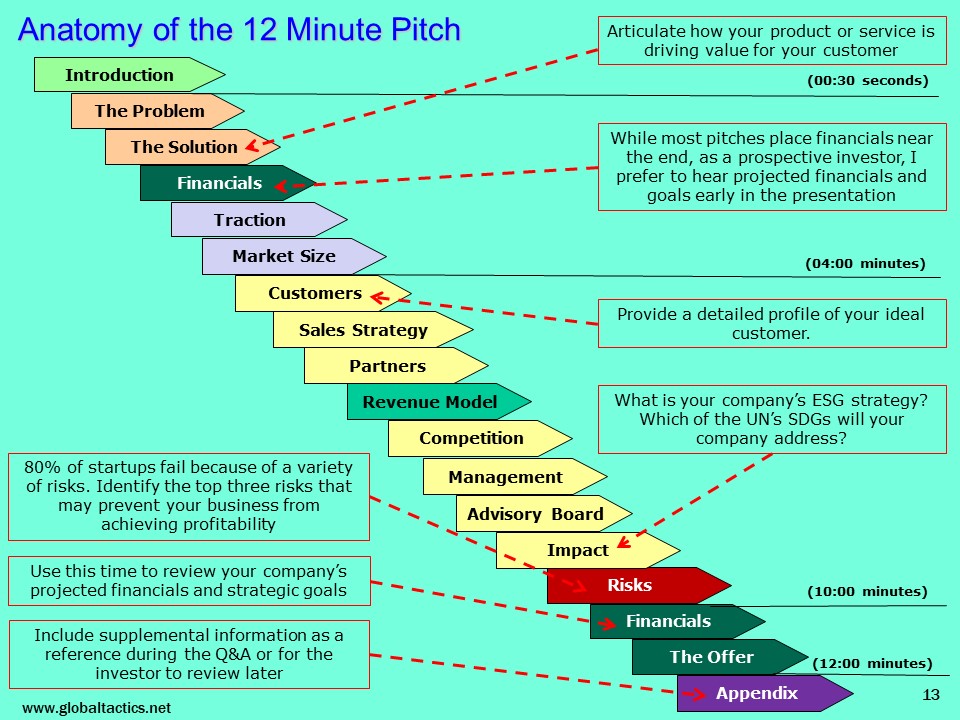
I recognize that most founders carry their pitch deck hoping show it to every investor they meet. I also acknowledge that most investors prefer to review a pitch deck (seems like Brad Feld and I are the only investors who prefer a conversation). However, if you are determined to show a pitch deck, then I recommend creating one based on the format in the image below.


With a focused pitch, you should be able to present the key points within 12 minutes leaving plenty of time to cover additional details during the Q&A with your prospective investor.

If you invest in startups, what are your expectations during the initial meeting with the startup founder?

Aaron Rose is a board member, corporate advisor, and co-founder of great companies. He also serves as the editor of GT Perspectives, an online forum focused on turning perspective into opportunity.